
At a Glance
A transperineal prostate biopsy collects tissue samples through the perineal skin (between the scrotum and anus) rather than through the rectum, guided by ultrasound and often fused with MRI images. Because the needle bypasses the bowel, severe infection and sepsis are significantly rarer than with the traditional transrectal route — one reason NICE (DG54) and the EAU now favour the transperineal approach.¹ ² It usually takes 20–45 minutes under local or general anaesthetic, and most men go home the same day. Prostate cancer is the most common cancer in men in the UK, with around 57,900 new cases every year (Cancer Research UK).³
Key takeaways:
- Through the skin, not the bowel — the needle passes through sterilised perineal skin, dramatically lowering the risk of introducing bacteria.
- Image-guided — live ultrasound, frequently fused with your MRI scan, targets suspicious areas precisely, including the hard-to-reach front of the prostate.
- Guideline-preferred — recommended by NICE (DG54) and the EAU; landmark trials TRANSLATE and PREVENT demonstrated its advantages.⁴ ⁵
- Often no routine antibiotics — the low infection risk means many centres avoid preventative antibiotics, supporting antimicrobial stewardship.²
- Day case — 20–45 minutes; home the same day; mild soreness and temporary blood in urine or semen are the common after-effects.
To confirm or rule out prostate cancer, doctors may recommend a biopsy — and based on the clinical evidence, UK practice and national guidelines now favour the transperineal approach. This guide explains what a transperineal prostate biopsy is, why it is performed, how it works, and how it supports targeted treatments such as focal therapy.
Watch: What is a transperineal prostate biopsy?
Core benefits and differences
The transperineal approach is increasingly the standard for prostate biopsies because of its clinical advantages — full spatial access to the prostate without the infection risks of the transrectal route:
- Lower risk of infection and sepsis⁵
- Better sampling of the entire prostate, including anterior (front) areas
- Significantly reduced risk of rectal bleeding
- Reduced need for broad-spectrum antibiotics, supporting antimicrobial stewardship²
- Higher detection of clinically significant cancer than transrectal ultrasound-guided biopsy⁴
Why is a transperineal biopsy performed?
Mr Tim Dudderidge explains what a transperineal biopsy is — why going through the perineum gives a direct, safe pathway for accurate prostate sampling.
Men are usually advised to have a biopsy when PSA levels are elevated and/or an MRI highlights areas of concern. The transperineal method is increasingly chosen because it is safer and precise: the needle passes through sterilised skin rather than the naturally bacteria-rich rectum, which lowers the risk of bacteria entering the bloodstream.
How the transperineal biopsy procedure works
It is usually an outpatient or day-case procedure — no overnight stay. The active procedure takes about 20–45 minutes, depending on the imaging used and the number of samples needed. Most men return home the same day.
Preparation before the biopsy
Your team will give you detailed instructions. If you are having a general anaesthetic you will likely fast (no food for 6 hours, clear fluids up to 2 hours before). You may need to pause blood-thinning medicines a few days in advance.
Current evidence, supported by the 2026 EAU guidelines, suggests routine preventative antibiotics are frequently unnecessary for transperineal biopsy because the baseline infection risk is very low² — though some clinics still prescribe them depending on your history. You will review and sign a consent form once benefits and risks have been explained.
Checklist before your biopsy:
- Follow fasting instructions if required
- Stop specific medications as directed
- Take any prescribed antibiotics exactly as instructed
- Arrange a lift home if you are having general anaesthetic or sedation
What happens during the procedure
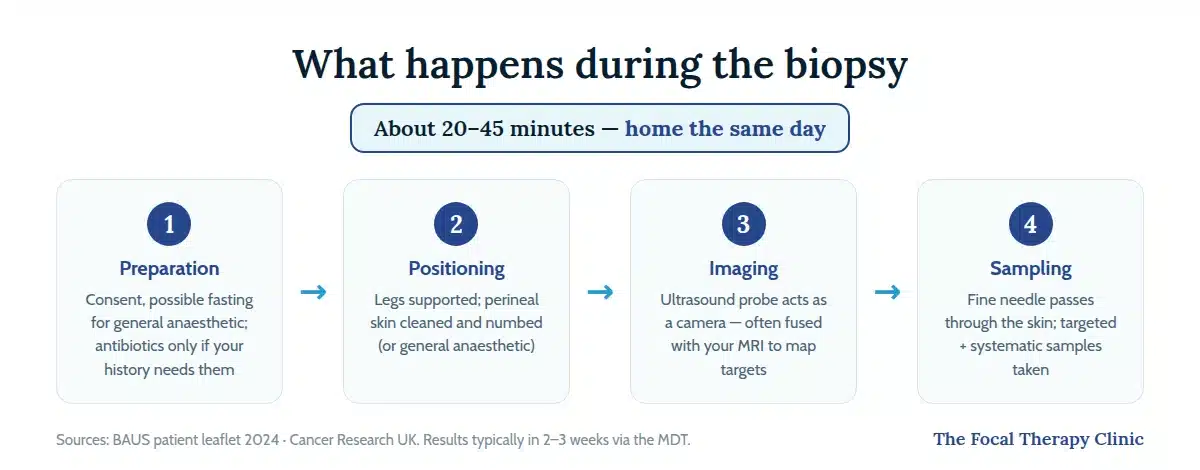
You change into a gown and lie on your back with your legs supported. The perineal skin is cleaned to create a sterile field. With local anaesthetic, the area is numbed by an injection that may sting briefly.
A smooth, lubricated ultrasound probe is gently placed in the rectum — it works purely as a camera creating a live image of the prostate; no biopsy needles pass through it. Guided by the images, the doctor passes a fine needle through the perineal skin to collect samples (you hear a clicking sound). If your MRI showed concerning areas, targeted samples are taken from those regions alongside systematic samples from the rest of the gland.
Use of local or general anaesthesia
Many transperineal biopsies are now done comfortably under local anaesthetic — the TRANSLATE trial was run specifically with local-anaesthetic transperineal biopsy.⁴ Some men are offered general or spinal anaesthetic instead: for a large prostate, extensive sampling, or simply preference. After a general anaesthetic you stay in recovery until the team is happy for you to go home.
Image guidance (MRI-ultrasound fusion)
Real-time ultrasound guides the needle safely. In modern clinics this is frequently combined with your recent MRI in a process called MRI-US fusion: the detailed MRI images are overlaid on the live ultrasound feed so the clinician can target suspicious lesions precisely. This is especially valuable for tumours in the anterior prostate, which the transrectal route struggles to reach.

Benefits of transperineal vs transrectal biopsy
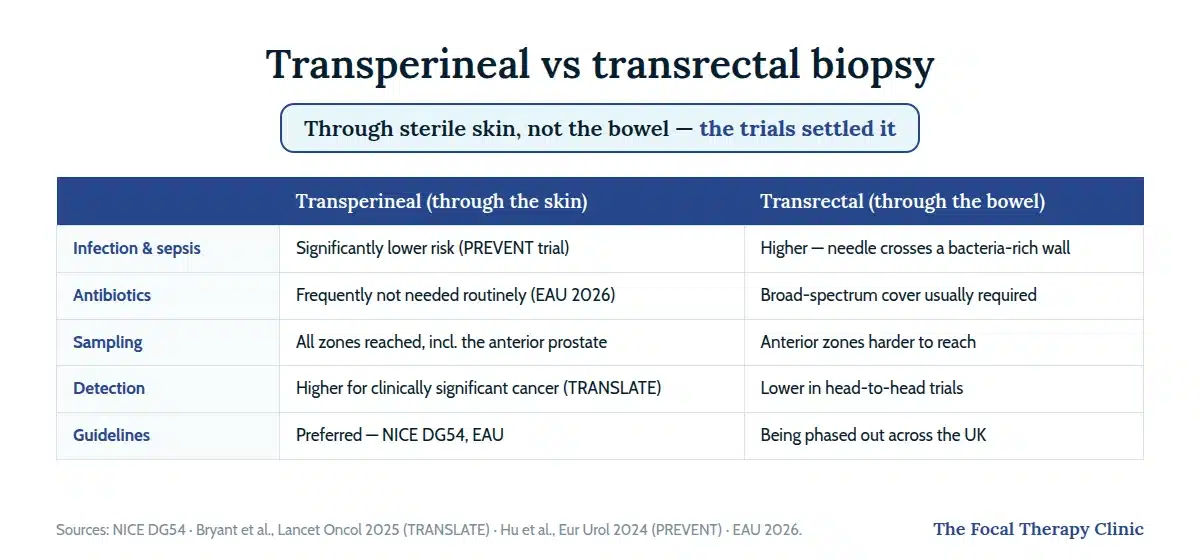
The transperineal approach is now a preferred option for NICE (DG54) and the EAU.¹ ² In the landmark TRANSLATE trial, local-anaesthetic transperineal biopsy detected more clinically significant cancer than the transrectal route, and the PREVENT trial confirmed fewer infectious complications without routine antibiotics.⁴ ⁵
- Infection and sepsis — significantly lower risk⁵
- Rectal bleeding — significantly reduced
- Access — geometric access to all zones of the prostate
- Detection — high detection of clinically significant cancer⁴
For a full description of the older transrectal route, see our article on TRUS-guided biopsy.
Risks and side effects
A transperineal biopsy is generally safe, but like any procedure it carries some risks. Most side effects are mild and settle within days to weeks.
Common: blood in the urine or semen, perineal soreness or bruising, temporary mild discomfort.
Less common: difficulty passing urine (occasionally needing a short-term catheter), temporary erectile changes from bruising, urinary tract infection requiring antibiotics.
Drinking plenty of fluids afterwards helps flush the bladder. Your team will tell you what to look out for and when to get in touch.
Get Expert Advice & The Latest Research
Subscribe to our newsletter to receive the latest updates, expert insights, and breakthrough research on prostate cancer-delivered straight to your inbox.
Recovery and aftercare
You can usually go home the same day — shortly after a local-anaesthetic procedure, or once you are fully awake, have eaten and drunk, and have passed urine after a general anaesthetic (no driving for at least 24 hours after a general).
Perineal discomfort is normal and usually managed with over-the-counter pain relief. Contact your doctor if you have: a high temperature or chills, difficulty passing urine, heavy or ongoing bleeding, or any symptom that worries you.
Your samples are examined by a specialist pathologist and discussed by a multidisciplinary team; results are typically ready within two to three weeks, and your doctor will explain the findings and next steps. A specialist nurse is available if you have questions in the meantime.
How much does a transperineal biopsy cost privately in the UK?
A private transperineal prostate biopsy in the UK typically costs around £3,000–£5,000, and an MRI–ultrasound fusion biopsy around £3,000–£6,000 — indicative market ranges, not Focal Therapy Clinic prices, so check exactly what a quote includes. On the NHS the biopsy is free once you are referred. For the full private pathway — consultation, mpMRI, biopsy and PSMA scan — and what each typically costs, see private prostate cancer diagnostics. At The Focal Therapy Clinic, a review of your existing MRI and biopsy is included in the fixed-price focal therapy package; a new biopsy, if one is needed, is arranged and charged separately, and the initial consultation is £250 including VAT.
How transperineal biopsy supports focal therapy
A transperineal biopsy provides a map of exactly where cancer sits in the prostate — the foundation for planning focal therapy, which targets the suspicious area while preserving healthy tissue.
The accuracy of transperineal MRI-US fusion biopsy enables detailed characterisation of tumour location, size and aggressiveness. At The Focal Therapy Clinic, this information lets our specialists design personalised treatment plans for HIFU (NICE HTG667) and NanoKnife (NICE HTG688) — in our audited series of 265 men, 97% maintained urinary continence and 90%+ preserved sexual function.
Speak to our specialists
Our clinicians — leading urologists, radiologists and oncologists with 75+ years of combined focal therapy experience across 2,500+ procedures — review every case in a multidisciplinary team to reach the most accurate diagnosis and the most suitable plan. Whether you want a second opinion or are exploring focal therapy, get in touch to book a consultation.
Frequently Asked Questions
Does a transperineal biopsy hurt?
With local anaesthetic, most men feel pressure and hear clicking rather than pain — the numbing injection stings briefly. Under general anaesthetic you feel nothing. Expect perineal soreness for a few days afterwards, manageable with ordinary pain relief.
Can I drive home afterwards?
After a local-anaesthetic biopsy, usually yes. After a general anaesthetic or sedation, no — arrange a lift and avoid driving for at least 24 hours.
How long do the results take?
Typically two to three weeks. Samples are reviewed by a specialist pathologist and discussed at a multidisciplinary team meeting before your doctor explains the findings and any next steps.
When can I have sex again?
As soon as you feel comfortable — most men wait a few days. You may notice blood in your semen for several weeks; it looks alarming but is harmless and settles by itself.
Will I need antibiotics?
Frequently not — the transperineal route’s infection risk is low enough that many centres skip routine preventative antibiotics, in line with 2026 EAU guidance.² Your team will decide based on your history.
How much does a transperineal biopsy cost in the UK?
Privately, a transperineal prostate biopsy typically costs around £3,000–£5,000 in the UK, and an MRI–ultrasound fusion biopsy around £3,000–£6,000 — indicative market ranges rather than fixed prices. It is free on the NHS once you are referred. At The Focal Therapy Clinic, review of an existing biopsy is included in the fixed-price treatment package; a new biopsy, if needed, is charged separately.
This content is not intended to be a substitute for professional medical advice, diagnosis, or treatment. Always seek the advice of your urologist or other qualified health provider with any questions you may have regarding a medical condition.
References
- National Institute for Health and Care Excellence. Transperineal biopsy for diagnosing prostate cancer (DG54). 2023. https://www.nice.org.uk/guidance/dg54
- European Association of Urology. EAU Guidelines on Prostate Cancer; EAU Guidelines on Urological Infections. 2026. https://uroweb.org/guidelines/prostate-cancer
- Cancer Research UK. Prostate cancer statistics. Accessed August 2026. https://www.cancerresearchuk.org/health-professional/cancer-statistics/statistics-by-cancer-type/prostate-cancer
- Bryant RJ, Marian IR, Williams R, et al. Local anaesthetic transperineal biopsy versus transrectal prostate biopsy in prostate cancer detection (TRANSLATE): a multicentre, randomised, controlled trial. Lancet Oncol. 2025;26(5):583–595.
- Hu JC, Assel M, Allaf ME, et al. Transperineal Versus Transrectal Magnetic Resonance Imaging-targeted and Systematic Prostate Biopsy to Prevent Infectious Complications: The PREVENT Randomized Trial. Eur Urol. 2024;86(1):61–68.
- British Association of Urological Surgeons. Transperineal prostate biopsies (patient leaflet). 2024. https://www.baus.org.uk/patients/information_leaflets/112/transperineal_prostate_biopsies