
At a Glance
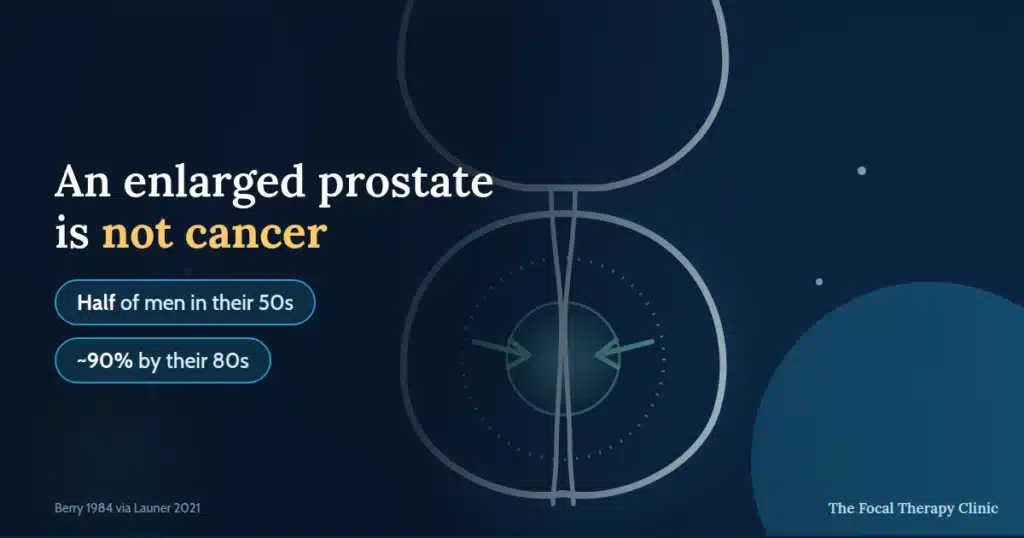
Benign prostatic hyperplasia (BPH) is a non-cancerous enlargement of the prostate that affects around half of men in their 50s, rising to around 90% of men in their 80s. The enlarged tissue compresses the urethra, causing weak flow, urgency and night-time urination. BPH is not prostate cancer, and it does not increase the risk of developing it.
Key takeaways:
- Not cancer — and not a cause of it — BPH grows in the transition zone around the urethra; most cancers begin in the peripheral zone.
- Symptoms build gradually — weak stream, hesitancy, urgency and nocturia, scored with the IPSS questionnaire (0–7 mild, 8–19 moderate, 20–35 severe).
- PSA can rise — a larger gland produces more PSA; MRI-first assessment under NICE NG131 separates benign enlargement from a suspicious lesion.
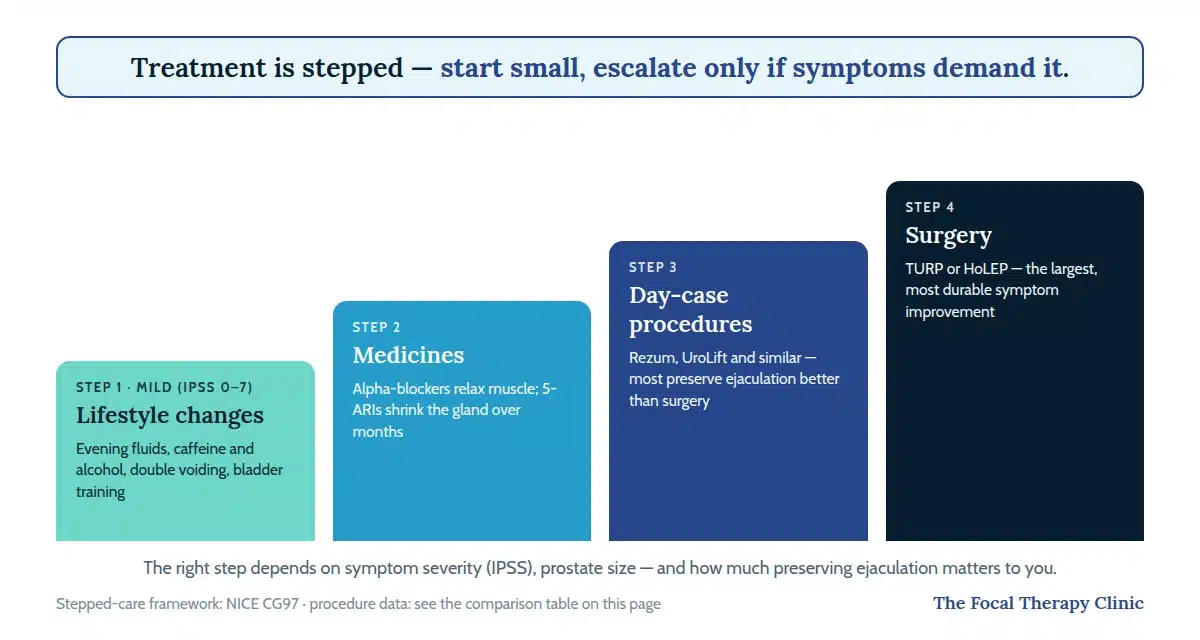
- Treatment is stepped — lifestyle changes, then medicines, then day-case procedures such as Rezum or UroLift, then surgery (TURP or HoLEP).
- Ask about ejaculation — side-effect profiles differ sharply between treatments, and preserving ejaculatory function drives satisfaction.
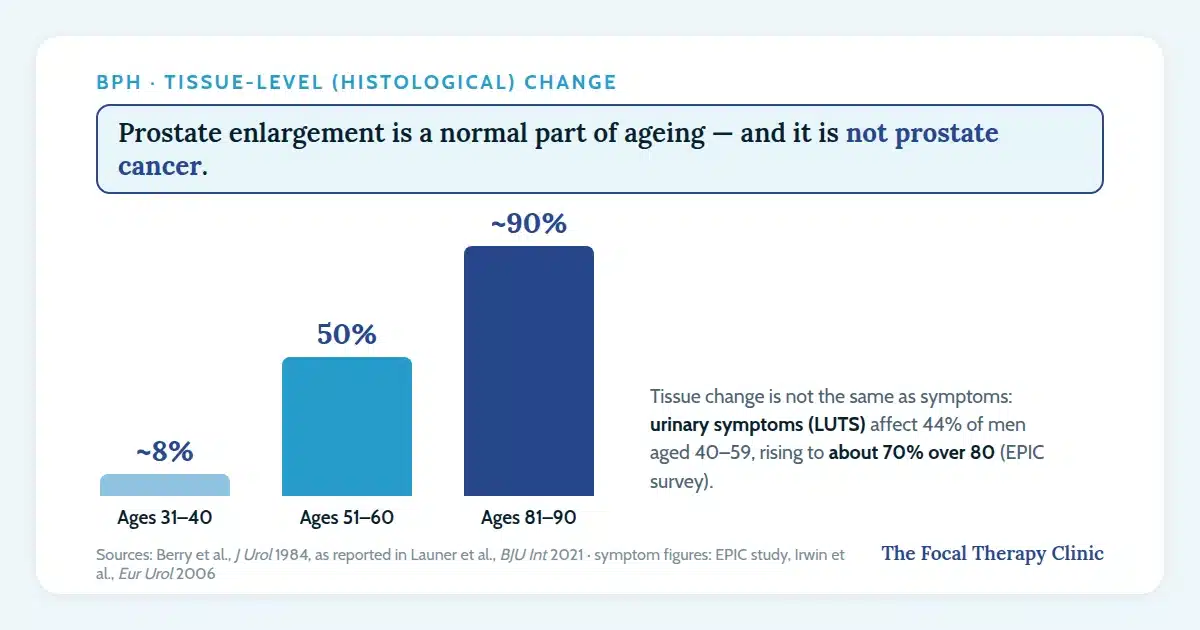
Benign prostatic hyperplasia (BPH) is a non-cancerous enlargement of the prostate that affects around half of men aged 51 to 60 and around 90% of men in their 80s (Berry et al., 1984, as reported in Launer et al., 2021). Not every man with these tissue changes gets symptoms: in the five-country EPIC population survey, urinary symptoms (LUTS) affected 44% of men aged 40–59, rising to about 70% of men over 80. Enlarged tissue grows around the urethra and compresses it, which can restrict urine flow and cause urinary symptoms. BPH is not prostate cancer.
Is BPH the Same as Prostate Cancer?
Dr Christos Mikropoulos explains the difference between benign prostate enlargement and prostate cancer — why an enlarged prostate does not mean cancer, and which symptoms warrant a check.
No. BPH and prostate cancer are separate conditions, and having BPH does not increase the risk of developing prostate cancer. BPH is an overgrowth of normal cells that cannot spread, while prostate cancer is malignant and can. Both can coexist because they usually begin in different parts of the gland. The early symptoms of prostate cancer may resemble signs of enlarged prostate, so benign prostatic hyperplasia vs prostate cancer cannot be decided from symptoms alone.
| Comparison | BPH | Prostate Cancer |
|---|---|---|
| Cell growth | Benign overgrowth of normal cells | Malignant growth that can invade or spread |
| Location in the prostate | Usually the transition zone around the urethra | Usually the peripheral zone |
| Effect on PSA | May raise PSA by increasing tissue volume | May raise PSA, but some cancers produce little PSA |
| Typical symptoms | Weak flow, urgency, frequency and nocturia | Often no early symptoms; later symptoms may overlap with BPH |
| Risk to life | Not cancerous, but severe obstruction can cause complications | Can become life-threatening if aggressive or advanced |
| Typical treatment | Monitoring, lifestyle changes, medicines, procedures or surgery | Monitoring, focal therapy, surgery, radiotherapy or systemic treatment |
Transition zone vs peripheral zone
BPH develops in the transition zone, the ring of tissue immediately surrounding the urethra, while about 70% of prostate cancers arise in the peripheral zone at the outer edge of the gland (68% in McNeal’s classic series, with 24% in the transition zone and 8% in the central zone). Growth in the transition zone compresses the urethra, so BPH often announces itself through urinary obstruction. Early prostate cancer is usually asymptomatic because most tumours begin farther from the urethra.
What Are the Symptoms of an Enlarged Prostate?
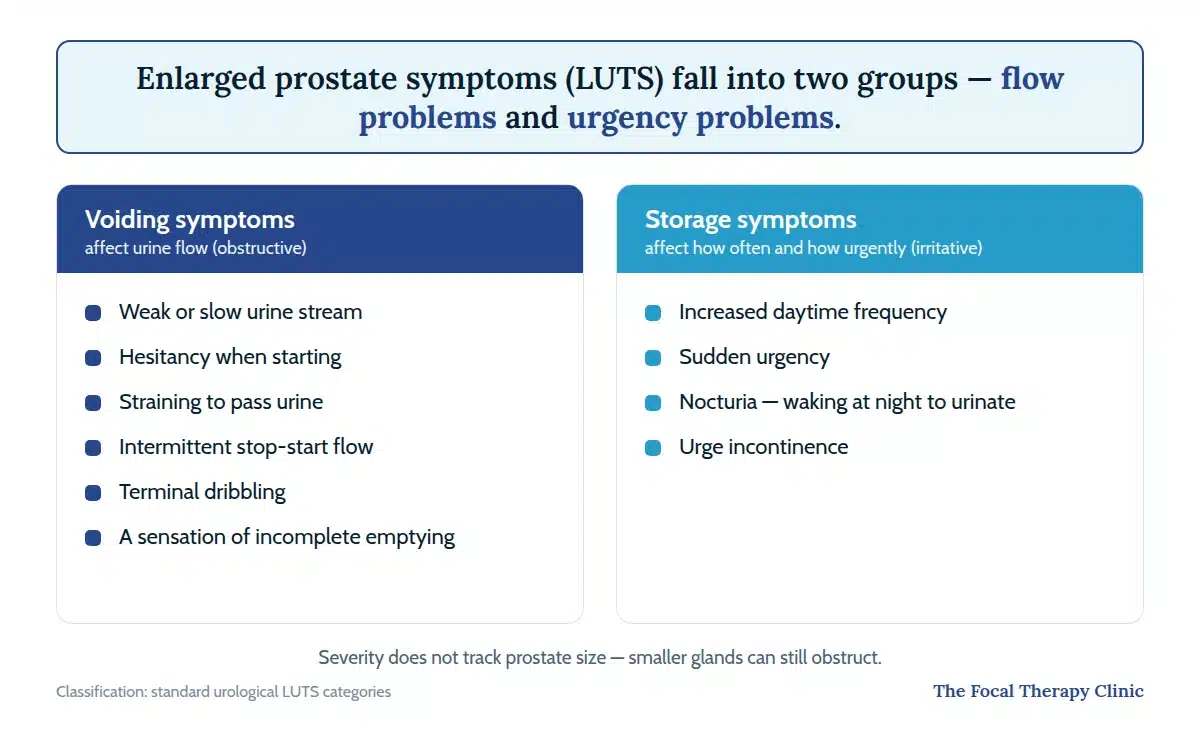
The symptoms of an enlarged prostate are collectively called lower urinary tract symptoms (LUTS) and divide into voiding symptoms and storage symptoms. Enlarged prostate symptoms usually develop gradually over several years rather than appearing at once. Symptom severity does not correlate reliably with prostate size, so a large gland may cause little trouble while a smaller enlargement can cause marked obstruction.
Voiding and storage symptoms
Voiding symptoms affect urine flow, while storage symptoms affect how often and how urgently the bladder signals a need to empty.
Voiding or obstructive symptoms:
- Weak or slow urine stream
- Hesitancy when starting
- Straining to pass urine
- Intermittent stop-start flow
- Terminal dribbling
- A sensation of incomplete emptying
Storage or irritative symptoms:
- Increased daytime frequency
- Sudden urgency
- Nocturia, or waking at night to urinate
- Urge incontinence
Most men experience a mixture of both groups.
Scoring symptom severity
Clinicians grade BPH severity using the International Prostate Symptom Score (IPSS), an eight-question self-assessment covering seven symptoms and quality of life. Scores of 0 to 7 are mild, 8 to 19 are moderate and 20 to 35 are severe. The IPSS and the impact on daily life, rather than prostate volume alone, drive the treatment decision.
What Causes BPH?
BPH is caused by age-related hormonal changes that drive cell proliferation in the transition zone. Dihydrotestosterone, or DHT, is the main hormonal driver, although the exact trigger for continued growth is not fully established. Chronic inflammation is also an active area of research, and Tong and Zhou (2020) described how androgen signalling and inflammation may interact in BPH tissue.
Hormonal changes and DHT
Testosterone is converted into dihydrotestosterone (DHT) by the enzyme 5-alpha reductase, and DHT is the primary hormonal driver of prostate cell growth. DHT remains active within the ageing prostate even as circulating testosterone falls, while a changing androgen-to-oestrogen balance may also contribute. This mechanism explains why 5-alpha reductase inhibitors can shrink the prostate and slow progression.
Risk factors and metabolic syndrome
Age is the dominant risk factor and cannot be modified, while most remaining factors can be influenced. Parsons (2010) linked BPH and male LUTS with several metabolic and lifestyle factors.
- Increasing age
- Family history
- Obesity
- Type 2 diabetes
- Metabolic syndrome
- Physical inactivity
Men asking what causes enlarged prostate should view these as associations, because several biological and metabolic factors may act together.
How Is BPH Diagnosed?
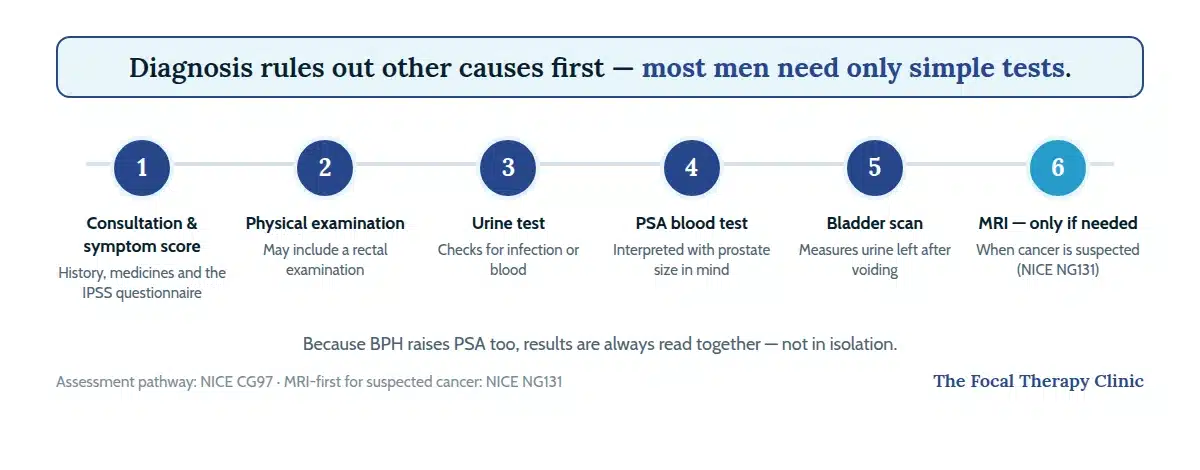
A BPH workup combines symptom scoring, digital rectal examination, urine and blood tests, and imaging. Its main purpose is to rule out prostate cancer, infection, bladder disease and other causes of urinary symptoms, rather than simply confirm common benign enlargement. NICE guideline CG97 sets out this assessment pathway.
Symptom assessment and examination
A first appointment covers the IPSS questionnaire, medical history, medicines, a bladder diary and physical examination. A clinician may perform a digital rectal examination, test urine for infection or blood, and use ultrasound to measure urine left after voiding. Benign enlargement often feels smooth, symmetrical and rubbery, while a hard, nodular or asymmetrical area may prompt further investigation.
PSA testing and interpretation
PSA is a prostate-specific marker, not a cancer-specific one. BPH raises PSA because a larger gland produces more of it, while infection, recent ejaculation, cycling and prostate manipulation can also affect the reading. A PSA test can be assessed with PSA density and the free-to-total PSA ratio to help distinguish a benign rise from a suspicious one.
Finasteride and dutasteride approximately halve measured PSA after six to twelve months. After at least six months, the measured result is usually doubled before interpretation, and any rise from its lowest level needs review.
MRI and fusion imaging
Multiparametric MRI (mpMRI) is a prostate scan taken before biopsy, and NICE guideline NG131 recommends it first for suspected localised prostate cancer. MRI scans for prostate cancer use a 1 to 5 score: 1 or 2 means significant cancer is unlikely, while 4 or 5 indicates a suspicious lesion. A low score, considered with PSA density and risk, can spare some men a biopsy.
A suspicious lesion can be sampled through a transperineal prostate biopsy, which has a lower infection risk than the transrectal route. The Focal Therapy Clinic uses MRI-ultrasound fusion technology to align scan findings with real-time ultrasound. This distinguishes benign nodules from significant cancer and guides targeting.
What Happens If BPH Is Left Untreated?
Most men with mild BPH never develop complications, and watchful waiting is a legitimate choice when symptoms remain manageable. Severe untreated obstruction can leave residual urine in the bladder, creating a reservoir for infection and stone formation, while sustained back pressure can eventually impair bladder muscle function.
- Recurrent urinary tract infections
- Bladder stones
- Haematuria, or visible blood in the urine
- Chronic urinary retention
- Bladder decompensation and poor emptying
- Obstructive renal impairment
Acute urinary retention is a sudden and complete inability to pass urine. It is a medical emergency requiring immediate attention.
Treatment Options for BPH
BPH treatment escalates from lifestyle change and watchful waiting through medication and minimally invasive day-case procedures to surgery. The right stage depends on IPSS severity, prostate size, complications and the importance of preserving ejaculatory function. Treatment decisions belong with a urologist.
Lifestyle adjustments
Lifestyle changes are first-line for mild BPH with an IPSS of 0 to 7. They will not shrink the prostate, but they can meaningfully reduce how much benign prostatic hyperplasia symptoms intrude on daily life.
- Reduce fluid intake in the evening without becoming dehydrated
- Limit caffeine and alcohol
- Use double voiding to empty the bladder more fully
- Practise bladder training
- Review diuretics and decongestants with a GP
- Treat constipation
- Work towards a healthy weight
- Exercise regularly
Medication options
The main drug classes are alpha-blockers, which relax smooth muscle, and 5-alpha reductase inhibitors, which reduce DHT and shrink the gland. Tamsulosin and alfuzosin work within days to weeks but may cause dizziness or ejaculatory changes. Finasteride and dutasteride work best in prostates over about 30 ml, take three to six months, and may reduce libido or erectile function.
Combination therapy can suit men with troublesome symptoms and a larger gland; the MTOPS trial found doxazosin plus finasteride reduced clinical progression by 66% versus placebo. Daily tadalafil may help when BPH coexists with erectile dysfunction. Choice depends on prostate size, blood pressure, sexual priorities and other medicines.
Minimally invasive procedures
Minimally invasive procedures relieve obstruction without traditional tissue resection and are usually day-case treatments under local or light anaesthesia. Most preserve ejaculation better than surgery, but durability can be lower.
Rezum uses water vapour to destroy obstructive tissue; McVary et al. (2021) reported durable five-year relief and a 4.4% surgical retreatment rate. UroLift holds tissue away from the urethra, while iTind temporarily reshapes the channel without leaving an implant. Roehrborn et al. (2017) reported durable UroLift improvement at five years with preserved sexual function.
Aquablation removes tissue with an image-guided waterjet, while prostate artery embolisation shrinks the gland by reducing blood supply. Lim et al. (2025) found lower reintervention after Rezum than UroLift.
Surgical treatment options
TURP, or transurethral resection of the prostate, is the reference standard for BPH treatment. It gives large, durable symptom improvement, but retrograde ejaculation occurs in about 65 to 75% of patients. HoLEP uses a holmium laser and is preferred for many very large glands, while open or robotic simple prostatectomy may suit glands above roughly 80 to 100 ml. Özkaptan et al. (2025) found stronger functional improvement after HoLEP than Rezum, while ejaculation preservation favoured Rezum.
Comparing treatment side effects
Preservation of ejaculatory function is one of the strongest predictors of satisfaction after BPH treatment. These are typical study ranges, and outcomes vary with anatomy, technique and operator experience.
| Treatment | Symptom relief (IPSS improvement) | Recovery time | Risk of retrograde ejaculation | Durability |
|---|---|---|---|---|
| Alpha-blockers | About 4 to 6 points | No procedure recovery | About 4 to 18%, depending on drug | Works only while taken |
| 5-ARIs | About 3 to 5 points | No procedure recovery | About 1 to 5% | Long-term while taken |
| UroLift | About 7 to 9 points | Several days | Under 1% in pivotal studies | Five-year surgical retreatment 13.6% (Roehrborn 2017) |
| Rezum | About 10 to 12 points | Several days to two weeks | About 0 to 3% | Five-year surgical retreatment 4.4% (McVary 2021) |
| Aquablation | About 14 to 16 points | One to three weeks | About 10% | Durable to five years |
| TURP | About 13 to 16 points | Four to six weeks | About 65 to 75% | Often 10 years or longer |
| HoLEP | About 15 to 20 points | Two to four weeks | About 70 to 80% | Often 10 years or longer |
The ranges draw on pivotal trials, BAUS TURP data and longer-term HoLEP evidence.
Can BPH Be Prevented?
No. Ageing is the underlying driver, so BPH cannot be fully prevented. Metabolic syndrome is associated with faster prostate growth and more troublesome LUTS, which means weight, blood glucose and activity may influence progression. These steps reduce risk and symptom burden rather than guarantee prevention.
- Maintain a healthy weight
- Keep blood glucose and blood pressure controlled
- Stay physically active
- Avoid smoking
- Limit excess alcohol
Get Expert Advice & The Latest Research
Subscribe to our newsletter to receive the latest updates, expert insights, and breakthrough research on prostate cancer-delivered straight to your inbox.
When to See a Specialist
A man should see a GP or urologist when symptoms affect sleep, work or quality of life, or when a red flag appears. The modern prostate cancer diagnostic pathway explains when PSA, MRI or biopsy is appropriate.
- Complete inability to pass urine
- Visible blood in the urine
- Fever alongside urinary symptoms
- Unexplained weight loss
- Persistent bone pain
- A rapidly rising PSA
These symptoms warrant urgent assessment rather than a wait-and-see approach.
Living Well With BPH
BPH is common, and troublesome symptoms are manageable rather than inevitable. The safest pathway is diagnosis first, followed by treatment matched to symptom severity, prostate anatomy and personal priorities. Regular review can identify progression and protect bladder function and quality of life.
Frequently Asked Questions
What is benign prostatic hyperplasia?
Benign prostatic hyperplasia (BPH) is a non-cancerous enlargement of the prostate caused by age-related hormonal changes. Growth occurs in the transition zone surrounding the urethra, where it can compress the urine channel and make urine harder to pass. It affects around half of men over 50.
Is BPH the same as prostate cancer?
No, BPH is a benign overgrowth of normal prostate cells that cannot spread, while prostate cancer is malignant and can spread. Having BPH does not increase the risk of developing prostate cancer. Both can coexist because BPH forms in the transition zone and most cancers form in the peripheral zone.
What are the first symptoms of BPH?
BPH symptoms fall into two groups. Some men first notice voiding changes, such as a weak stream, difficulty starting or flow that stops and starts. Others notice storage symptoms first, including urinating more often, sudden urgency or waking several times during the night.
Does BPH raise your PSA level?
Yes, BPH can raise a PSA test result because a larger prostate produces more PSA, so an elevated result does not automatically mean cancer. Infection, recent ejaculation and cycling can also affect PSA. Finasteride or dutasteride can roughly halve the reading, which must be considered during interpretation.
Can you have BPH and prostate cancer at the same time?
Yes, and both conditions become more common with age. They develop independently in different parts of the gland, so one does not cause or protect against the other. An mpMRI scan can identify a suspicious lesion alongside benign enlargement, although biopsy is needed to confirm cancer.
Can lifestyle changes prevent BPH?
No, lifestyle changes cannot fully prevent the prostate from enlarging with age, but they may reduce progression risk. BPH is associated with metabolic syndrome, so maintaining a healthy weight, controlling blood sugar and staying active are sensible measures. These steps reduce risk rather than eliminate it.
What complications can arise from untreated BPH?
Poor bladder emptying can leave urine behind, increasing the risk of recurrent urinary tract infections and bladder stones. Sustained back pressure can weaken the bladder muscle and, rarely, impair the kidneys. A sudden and complete inability to urinate is acute urinary retention, which is a medical emergency.
Get a Clear Answer on Your Prostate Symptoms
Urinary symptoms rarely mean cancer, but imaging is the only way to establish whether a suspicious lesion is present. The Focal Therapy Clinic uses an MRI-first pathway with MRI-ultrasound fusion imaging, and its multidisciplinary team reviews every case. Our consultants bring more than 75 years of combined focal therapy experience and have carried out more than 2,500 focal therapy procedures; in our audit of 265 patients, 97% of men maintained urinary continence and 90%+ preserved sexual function. Where tests confirm localised cancer, HIFU and NanoKnife offer tissue-preserving alternatives to surgery or radiotherapy, so book a consultation to review the next steps via focal therapy.
References
References verified via PubMed, 26 August 2026.
- Berry SJ, Coffey DS, Walsh PC, Ewing LL. The development of human benign prostatic hyperplasia with age. J Urol 1984;132(3):474–9. PMID 6206240.
- McNeal JE, Redwine EA, Freiha FS, Stamey TA. Zonal distribution of prostatic adenocarcinoma: correlation with histologic pattern and direction of spread. Am J Surg Pathol 1988;12(12):897–906. PMID 3202246.
- McConnell JD, Roehrborn CG, Bautista OM, et al. The long-term effect of doxazosin, finasteride, and combination therapy on the clinical progression of benign prostatic hyperplasia (MTOPS). N Engl J Med 2003;349(25):2387–98. PMID 14681504.
- McVary KT, Gittelman MC, Goldberg KA, et al. Final 5-year outcomes of the multicenter randomized sham-controlled trial of Rezūm water vapor thermal therapy. J Urol 2021;206(3):715–724. PMID 33872051.
- Roehrborn CG, Barkin J, Gange SN, et al. Five year results of the prospective randomized controlled prostatic urethral L.I.F.T. study. Can J Urol 2017;24(3):8802–8813. PMID 28646935.
- Lim CY, Lai CC, Tsai YW, et al. Comparative effectiveness of Rezum and UroLift for benign prostatic hyperplasia. Cureus 2025;17(3):e80914. PMID 40125525.
- Özkaptan O, Sevinç C, Çanakcı C, et al. Functional and ejaculatory outcomes after HoLEP and Rezum. World J Urol 2025;43(1):242. PMID 40263139.
- Rassweiler J, Teber D, Kuntz R, Hofmann R. Complications of transurethral resection of the prostate (TURP) — incidence, management, and prevention. Eur Urol 2006;50(5):969–79. PMID 16469429.
- Launer BM, McVary KT, Ricke WA, Lloyd GL. The rising worldwide impact of benign prostatic hyperplasia. BJU Int 2021;127(6):722–8. PMID 33124118. (confirms Berry’s ninth-decade ~90% histological figure)
- Irwin DE, Milsom I, Hunskaar S, et al. Population-based survey of urinary incontinence, overactive bladder, and other lower urinary tract symptoms in five countries: results of the EPIC study. Eur Urol 2006;50(6):1306–14. PMID 17049716.
This information is for educational purposes and does not replace professional medical advice. All treatment decisions should be made in consultation with a qualified healthcare professional.