
At a Glance
Brachytherapy treats prostate cancer by placing radioactive material directly inside the prostate — either permanent low-dose seeds (LDR) or a temporary high-dose source (HDR). It is an established option for localised and favourable intermediate-risk disease in UK guidance (NICE NG131),¹ usually as a day case or single overnight stay. Men comparing options may also wish to discuss focal therapy, which The Focal Therapy Clinic’s consultants have delivered across 2,500+ procedures.
Key takeaways:
- Two main types — LDR uses permanent radioactive seeds; HDR delivers high-dose radiation through temporary catheters.
- Who it’s for — men with localised or favourable intermediate-risk prostate cancer who want to avoid major surgery.
- Recovery — typically a day case or single overnight admission; most men return to normal activities within a few weeks.
- Side effects — urinary symptoms are common short term; erectile dysfunction risk depends on baseline function and treatment type.
- Vs focal therapy — brachytherapy still treats the whole gland; focal therapy targets only the cancer area, aiming to preserve urinary and sexual function in selected patients.
What is brachytherapy?
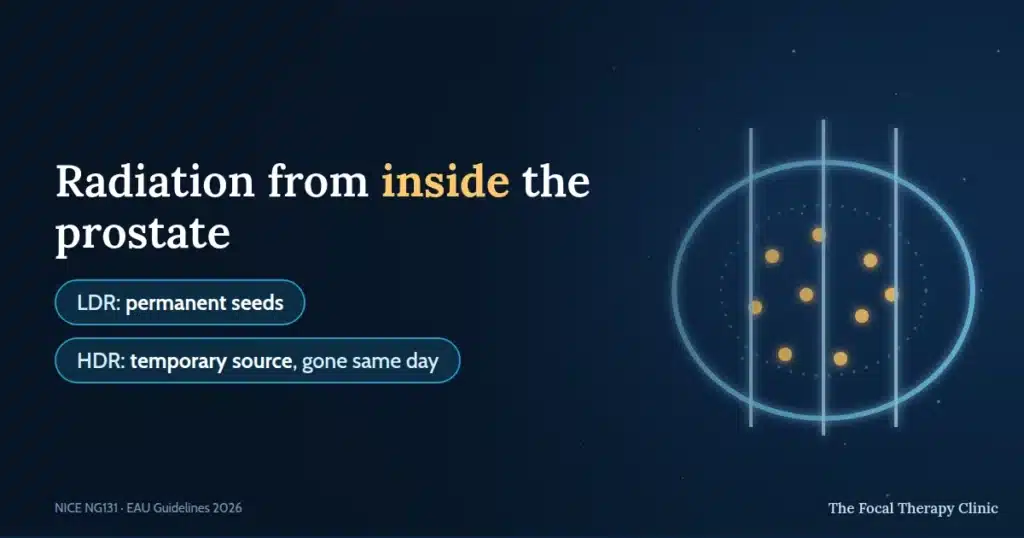
Brachytherapy places radioactive material inside the prostate itself. This highly conformal technique delivers a high, concentrated radiation dose to the cancer cells while limiting exposure to nearby healthy structures such as the bladder and rectum. It is most commonly used for men with early or favourable intermediate-risk prostate cancer.¹
How brachytherapy works
Small radioactive sources placed in the prostate emit radiation that damages the DNA of cancer cells, stopping them dividing and growing. The team uses real-time imaging guidance — usually ultrasound, sometimes with MRI — to place the sources accurately. The procedure is performed under general or spinal anaesthetic in hospital.
LDR vs HDR brachytherapy
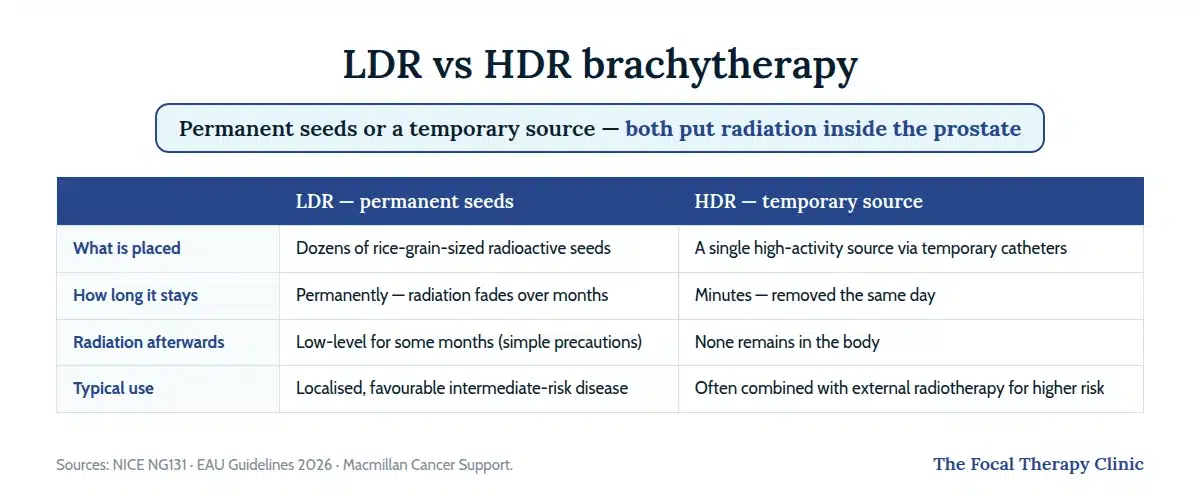
There are two main types. Both aim to treat the cancer effectively but differ in how the dose is delivered.
| LDR (low dose rate) | HDR (high dose rate) | |
|---|---|---|
| What is placed | Dozens of permanent radioactive seeds, each about the size of a grain of rice | A single high-activity source passed through temporary catheters |
| How long it stays | Permanently — radiation fades over several months | Minutes — source and catheters removed the same day |
| Radiation afterwards | Low-level emission for some months (simple precautions apply) | None — no radioactive material remains |
| Typical use | Localised, favourable intermediate-risk disease | Often combined with external beam radiotherapy for higher-risk disease |
Low dose rate (LDR)
LDR — often called permanent seed implantation — places dozens of tiny metallic seeds in the prostate. They release low-energy radiation continuously and slowly over several months; as the isotope decays, emission gradually falls until the seeds are biologically inactive.
High dose rate (HDR)
HDR delivers a high radiation dose over a very short time from a temporary source passed through a network of fine catheters in the prostate. After the calculated treatment time, the source and catheters are removed — giving the team precise control over the dose, with no radioactivity left in the body.
Who is brachytherapy suitable for?
Brachytherapy is not indicated for every patient. Specialist multidisciplinary assessment weighs cancer stage, prostate volume, baseline urinary symptoms and overall health.¹
- Men with localised prostate cancer — it works best when the cancer is confined to the prostate; for favourable intermediate-risk disease it provides targeted treatment with strong cancer-control outcomes. It is not generally recommended alone for high-risk disease.
- Men seeking to avoid major surgery — no large incisions and no gland removal mean shorter recovery, usually a day case or one night in hospital.
- Men less suited to surgery — those not medically fit for a prolonged operation may still be candidates for brachytherapy.
Existing significant urinary symptoms or a very large prostate can count against brachytherapy — part of why specialist assessment matters.
What happens during brachytherapy?
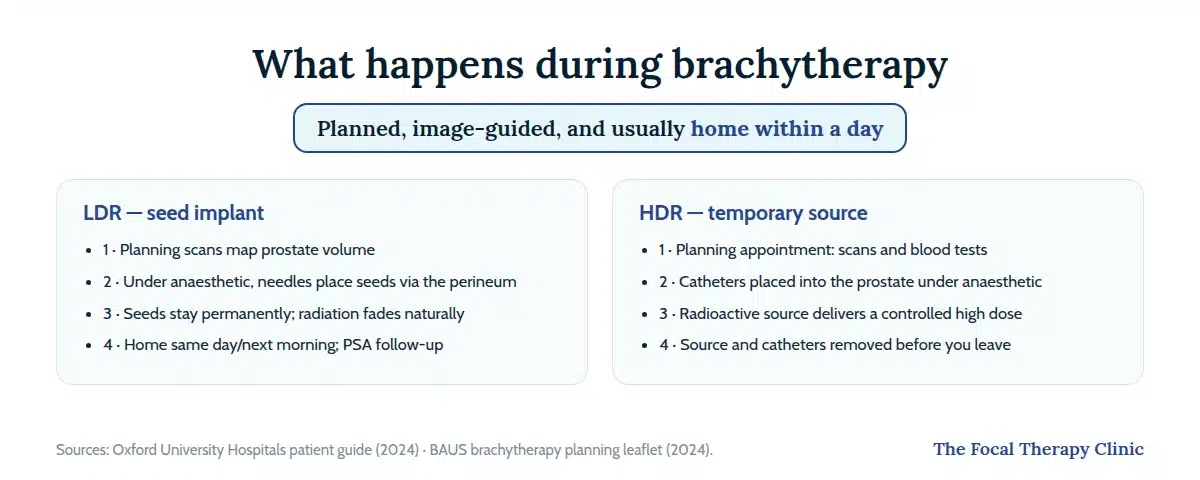
LDR step by step
- Planning — scans map the prostate’s exact volume so the medical physics team can plan seed distribution.
- The procedure — under general or spinal anaesthetic, fine needles pass through the skin between the scrotum and anus (the perineum), placing seeds under imaging guidance.
- Afterwards — the seeds stay permanently, releasing radiation slowly; radioactivity fades naturally over months.
- Follow-up — most men go home the same day or next morning; PSA is monitored and the team explains temporary precautions.
HDR step by step
- Planning — scans, blood tests and prostate review map the treatment area.
- The procedure — under anaesthetic, thin catheters are placed into the prostate through the perineum and checked with imaging.
- Treatment — the radioactive source passes through the catheters for a calculated time, delivering a controlled high dose.
- Completion — source and catheters are removed before you leave; no radiation remains in the body.
Effectiveness of brachytherapy
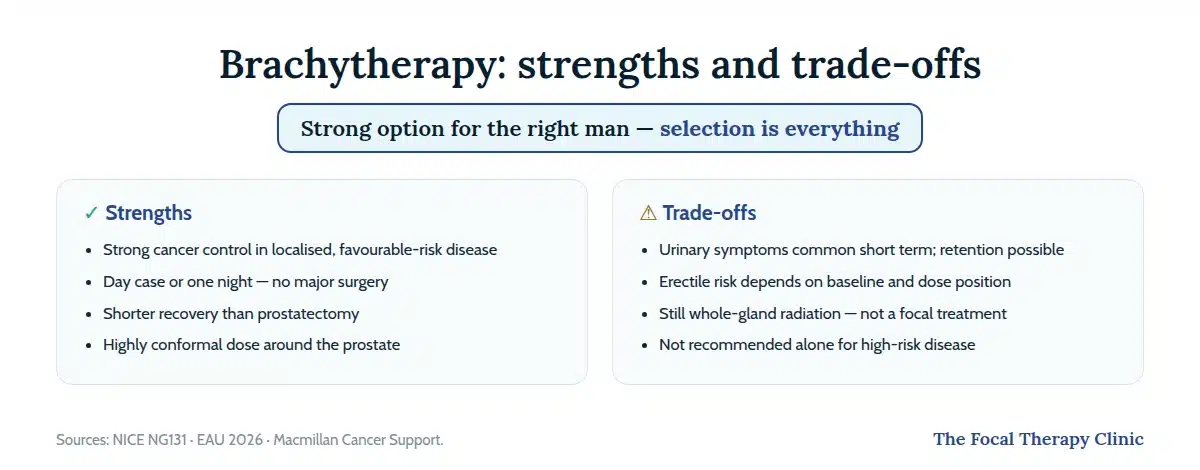
Brachytherapy is well studied and recognised in UK and European guidance as an effective option for suitable men.¹ ² Long-term cancer control depends heavily on the starting stage and grade of the tumour.
- For localised, lower-risk disease, LDR brachytherapy delivers cancer-control rates comparable to surgery or external beam radiotherapy in guideline reviews.¹ ²
- For higher-risk disease, brachytherapy is usually combined with external beam radiotherapy and hormone therapy to improve biochemical progression-free survival, rather than used alone.²
Long-term PSA monitoring continues after treatment, whichever route is chosen.
Get Expert Advice & The Latest Research
Subscribe to our newsletter to receive the latest updates, expert insights, and breakthrough research on prostate cancer-delivered straight to your inbox.
Side effects and recovery
Dr Christos Mikropoulos explains the side effects of brachytherapy — what internal radiotherapy can mean for urinary, bowel and sexual function.
Like all prostate cancer treatments, brachytherapy has side effects that vary between individuals, depending on dose and baseline urinary function.
Short term — lower urinary tract symptoms are common: urgency, frequency or discomfort. A small proportion of men experience temporary urinary retention needing a catheter. Mild fatigue and transient bowel irritation can occur. Symptoms usually peak within the first few weeks and settle gradually.³
Long term — urinary changes or erectile dysfunction can occur; the likelihood depends strongly on baseline potency and how close the dose sits to the neurovascular bundles. These risks are generally lower than with more invasive whole-gland treatments but are not eliminated.³
Safety around others
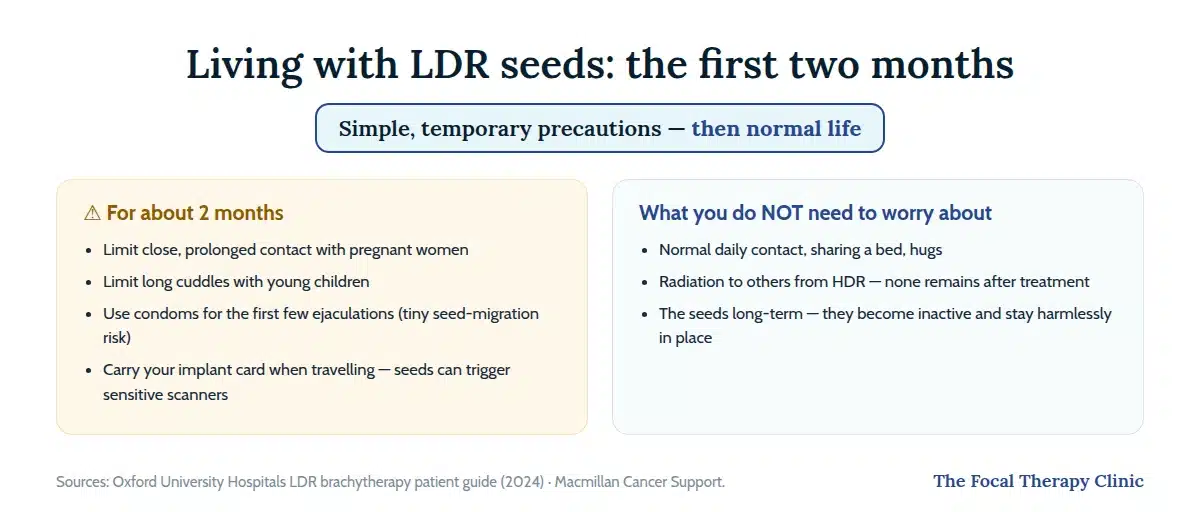
- LDR: because permanent seeds emit low-level radiation for several months, national guidance sets simple precautions — limit close, prolonged contact with pregnant women and young children for around the first two months, and use condoms for the first few ejaculations because of a very small risk of seed migration.⁴ These are temporary and fully explained by your team.
- HDR: no radioactive sources remain after treatment — no restrictions on contact with others.
Is brachytherapy right for you?
The right pathway depends on both clinical and personal factors, decided through shared decision-making with multidisciplinary guidance:
- Stage and grade of the cancer — see our guide to the stages of prostate cancer
- Prostate size and anatomy
- Baseline urinary function and overall health
- Personal priorities about side effects and recovery
Questions to ask your consultant:
- What outcomes should I expect from brachytherapy for my stage and grade?
- Which side effects are most likely in my case, and how would they be managed?
- Are there alternatives — surgery, external radiotherapy, or focal therapy — I should weigh before deciding?
How The Focal Therapy Clinic can help
The Focal Therapy Clinic offers expert guidance for men exploring treatment options. Our consultant urological surgeons hold 75+ years of combined focal therapy experience across 2,500+ procedures, at 8 hospital sites across six UK cities, and review each case in a multidisciplinary setting.
For selected men with localised disease, HIFU (NICE HTG667) and NanoKnife (NICE HTG688) treat only the cancerous area rather than the whole gland — in FTC’s audited series of 265 men, 97% maintained urinary continence and 90%+ preserved sexual function. We also provide detailed second opinions if you are weighing brachytherapy against other routes. Learn more about focal therapy and our fees.
Frequently Asked Questions
Am I radioactive after brachytherapy?
After HDR, no — nothing radioactive remains in your body. After LDR, the implanted seeds emit low-level radiation for several months, so you’ll follow simple temporary precautions: limit close, prolonged contact with pregnant women and young children for around two months, and use condoms for the first few ejaculations.⁴
Will LDR seeds set off airport security scanners?
They can occasionally trigger sensitive detectors in the months after implant. Your team can provide a treatment card confirming the implant — worth carrying if you fly soon after treatment.⁴
How do doctors choose between LDR and HDR?
Mainly by risk group and treatment plan: LDR alone suits localised, favourable-risk disease, while HDR is more often combined with external beam radiotherapy for higher-risk cancers. Prostate size, urinary symptoms and local availability also play a part.¹ ²
How quickly can I get back to normal life?
Most men go home the same day or next morning and return to normal activities within a few weeks. Urinary symptoms are the main short-term nuisance and usually settle over weeks to a few months.³
How does brachytherapy compare with focal therapy?
Both avoid major surgery, but brachytherapy still irradiates the whole gland, while focal therapy (HIFU or NanoKnife) treats only the cancerous area, aiming to preserve urinary and sexual function — in the largest UK focal HIFU series (625 men), failure-free survival was 88% at five years.⁵ Which suits you depends on your cancer’s position, grade and your priorities; a multidisciplinary review covers both honestly.
This content is not intended to be a substitute for professional medical advice, diagnosis, or treatment. Always seek the advice of your urologist or other qualified health provider with any questions you may have regarding a medical condition.
References
- National Institute for Health and Care Excellence. Prostate cancer: diagnosis and management (NG131). 2019, updated 2021. https://www.nice.org.uk/guidance/ng131
- European Association of Urology. EAU Guidelines on Prostate Cancer. 2026. https://uroweb.org/guidelines/prostate-cancer
- Macmillan Cancer Support. Brachytherapy for prostate cancer. 2026. https://www.macmillan.org.uk/cancer-information-and-support/treatments-and-drugs/brachytherapy-for-prostate-cancer
- Oxford University Hospitals NHS Foundation Trust. Low dose rate prostate brachytherapy (patient information). 2024. https://www.ouh.nhs.uk/media/hmilmtjv/91017brachytherapy.pdf
- Guillaumier S, Peters M, Arya M, et al. A Multicentre Study of 5-year Outcomes Following Focal Therapy in Treating Clinically Significant Nonmetastatic Prostate Cancer. Eur Urol. 2018;74(4):422–429.
- British Association of Urological Surgeons. Brachytherapy planning for prostate cancer (patient leaflet). 2024. https://www.baus.org.uk/_userfiles/pages/files/patients/leaflets/Brachy%20planning.pdf