
At a Glance
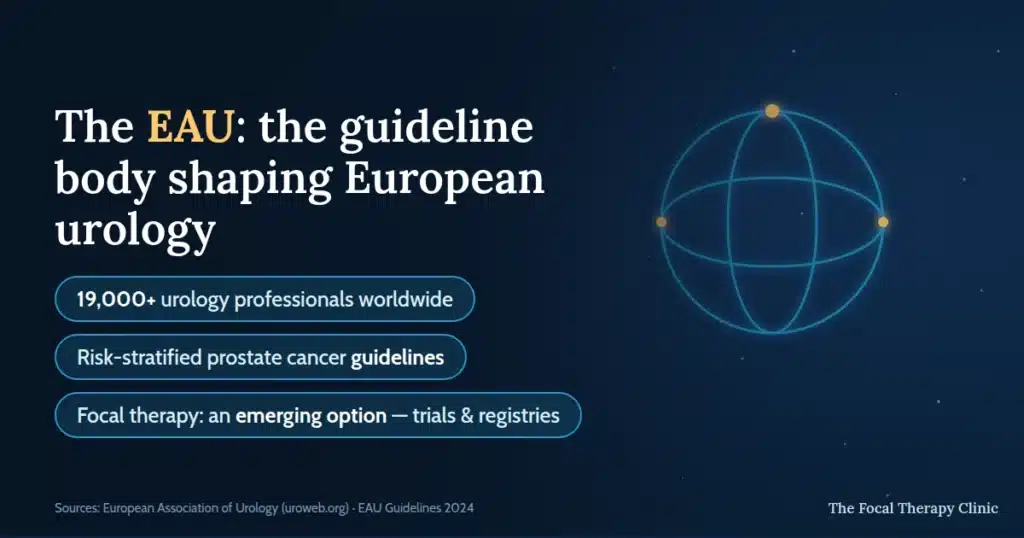
The European Association of Urology (EAU) is one of the most influential organisations in world urology. It develops widely used, evidence-based guidelines that shape how conditions such as prostate cancer are diagnosed and treated across Europe and beyond.
At The Focal Therapy Clinic, these same guidelines sit alongside UK bodies such as NICE and BAUS to inform every stage of decision-making. This combination of international and national standards helps ensure men receive modern, evidence-based care with a clear focus on both cancer control and quality of life.
Key takeaways:
- The EAU is a non-profit professional body representing more than 19,000 urology professionals worldwide, providing guidelines, education and research support.
- Its prostate cancer guidelines are a key reference for best practice in Europe, including the UK, and are updated regularly as new evidence emerges.
- For localised prostate cancer, the EAU recommends risk-stratified care — active surveillance as the standard for suitable men with low-risk disease, and whole-gland treatments such as radical prostatectomy or radiotherapy for higher-risk cancers.
- The EAU currently regards focal therapy (such as HIFU or cryotherapy) as an emerging treatment, advising that these procedures be offered within clinical trials or prospective registries because long-term cancer control data are still maturing.
- Membership involves ongoing education, participation in the EU-ACME continuing medical education system, and engagement with international research and training.
- Consultants at The Focal Therapy Clinic use EAU and NICE guidance, alongside high-quality imaging and detailed follow-up, to offer precision-led, minimally invasive options such as focal therapy where appropriate — with honest discussion of benefits and limitations.
For men and their families, choosing clinicians who align their practice with EAU guidance helps ensure care is safe, up to date, and benchmarked against international standards. The EAU does not “endorse” individual clinics, but its guidance provides the framework good clinics choose to follow.
What Is the European Association of Urology (EAU)?
Founded in 1973, the EAU is a non-profit organisation that represents urology professionals across Europe and increasingly worldwide.
Its purpose is straightforward:
- to raise standards of urological care
- to produce high-quality, evidence-based guidelines
- to support education, training and research in urology
The EAU is structured around an Executive Board, multiple specialist offices (such as Guidelines, Education, Oncology and Research), and a central office based in Arnhem in the Netherlands.
More than 19,000 medical professionals are members of the EAU, including urologists, specialist nurses and researchers. This wide membership ensures that everything from surgical technique to survivorship and patient information is considered when guidelines and educational materials are developed.
In the UK, the EAU sits alongside organisations such as the British Association of Urological Surgeons (BAUS) and NICE, complementing their work by providing a Europe-wide perspective on best practice.
The role of the EAU in shaping urology worldwide
The EAU is one of the main drivers of international standards in urology. It:
- Produces open-access clinical guidelines on conditions such as prostate, bladder, kidney and testicular cancer, as well as benign conditions like urinary incontinence and stone disease.
- Organises the Annual EAU Congress, the largest urology meeting in the world, with more than 12,000 delegates at some meetings.
- Runs the European School of Urology (ESU), which delivers courses, masterclasses and online learning at European and national meetings.
- Collaborates closely with national and international societies, including the American Urological Association (AUA), to encourage consistent, evidence-based care globally.
For doctors at The Focal Therapy Clinic, these activities are not abstract. They shape how we:
- use MRI and targeted biopsies to diagnose prostate cancer
- counsel men on the pros and cons of active surveillance, surgery, radiotherapy and focal approaches
- follow patients after treatment and monitor long-term outcomes
EAU membership and professional excellence
Being a member of the EAU is not just another credential. It reflects an ongoing commitment to:
- staying up to date with guidelines and new evidence
- taking part in high-quality education
- contributing to clinical audit and research
A key part of this is the EU-ACME (European Urology Accredited Continuing Medical Education) programme, which was set up jointly by the EAU and the European Board of Urology.
Through EU-ACME, EAU members can:
- track CME/CPD points from conferences, courses, publications and e-learning
- access accredited online education
- obtain annual reports of their educational activity
At The Focal Therapy Clinic, EAU membership is part of our consultants’ professional identity. It underpins regular attendance at EAU meetings, involvement in guideline-relevant research and continuous refinement of our prostate cancer pathways.
The EAU and Prostate Cancer Treatment
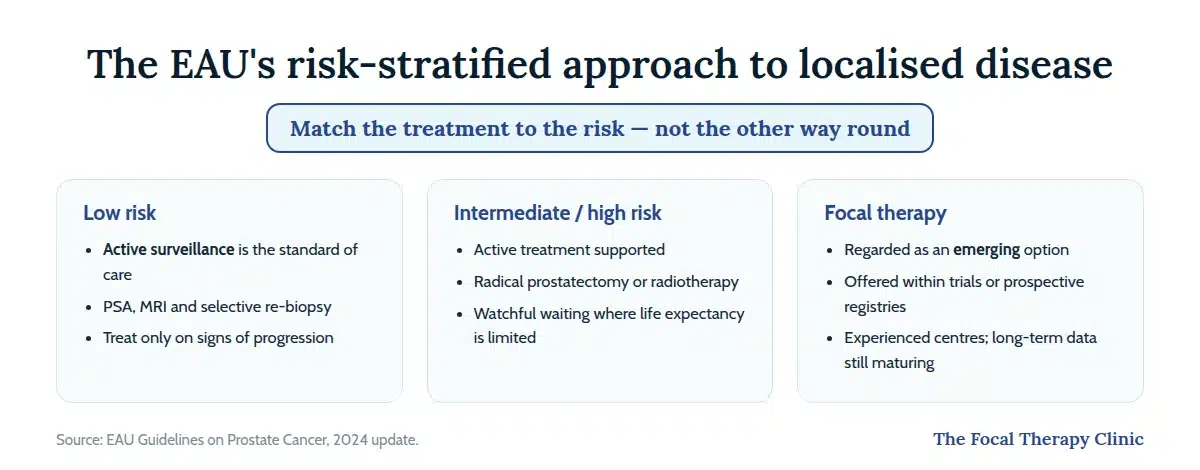
The EAU prostate cancer guidelines are built around risk: how aggressive the cancer looks, how far it has spread, and the man’s overall health. For localised prostate cancer, they recommend active surveillance as a standard approach for suitable men with low-risk disease. This means careful monitoring with PSA tests, MRI and potentially repeat biopsies rather than rushing into treatment straight away. For men with intermediate- or high-risk cancer, or those who show signs of progression on surveillance, the guidelines support active treatment such as surgery or radiotherapy. For men with a limited life expectancy, the focus may be watchful waiting, aiming to control symptoms rather than cure.
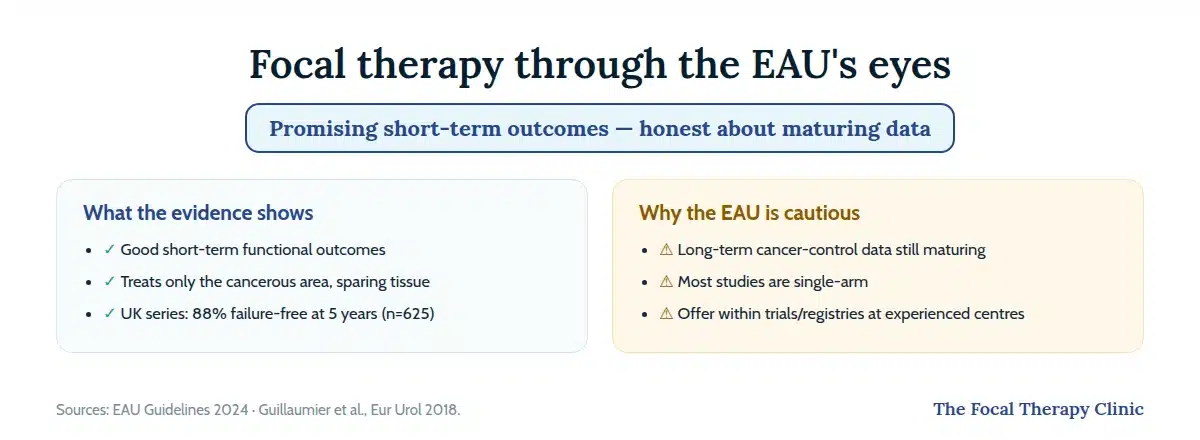
Focal therapy sits in a different category. Techniques such as HIFU, cryotherapy and NanoKnife IRE (Irreversible Electroporation) aim to treat only the cancerous part of the prostate and spare the rest. The EAU currently regards these as emerging options. Because long-term cancer control data are still developing and studies are mostly single-arm, the EAU advises that focal therapy should be offered only within clinical trials or prospective registries, and only in experienced centres. UK NICE guidance says essentially the same thing: safety data are reassuring, but long-term effectiveness compared with surgery or radiotherapy is not yet fully established.
In day-to-day practice at The Focal Therapy Clinic, this means that:
- Focal therapy is discussed as one option for carefully selected men with MRI-visible, localised disease, not as a universal replacement for surgery or radiotherapy.
- We are explicit that it is an evolving treatment, with less long-term data than whole-gland therapies, even though short-term functional outcomes are often very good.
- Decisions are made through shared decision-making, weighing guideline advice, the wider evidence base and each man’s own priorities for cancer control and quality of life.
How EAU membership enhances care at The Focal Therapy Clinic
Clinicians at The Focal Therapy Clinic do not simply “follow” EAU guidelines; they work within the same culture of evidence, audit and education that produced them.
Several of the clinic’s leading consultants are proud members of the European Association of Urology:
- Mr Alan Doherty, FRCS (Urol) (GMC: 3279241) — internationally recognised prostatectomy surgeon and expert in MRI-US fusion HIFU and NanoKnife therapies
- Mr Tim Dudderidge, FRCS (Urol) (GMC: 4505451) — a leader in MRI-US fusion HIFU, NanoKnife, cryotherapy and robotic prostatectomy
- Mr Marc Laniado, FRCS (Urol) (GMC: 3343931) — specialist in precision diagnostics and minimally invasive prostate cancer treatments, including MRI-US fusion HIFU, NanoKnife and robotic prostatectomy
- Mr Raj Nigam, FRCS (Urol) (GMC: 3265226) — leading expert in MRI-US fusion HIFU, NanoKnife, cryotherapy, and male fertility and sexual function
With decades of combined experience, these consultants bring a balance of surgical and non-surgical expertise to each case. Their leadership ensures the clinic remains at the forefront of precision-led prostate cancer care.
Get Expert Advice & The Latest Research
Subscribe to our newsletter to receive the latest updates, expert insights, and breakthrough research on prostate cancer-delivered straight to your inbox.
Why EAU membership matters for patients
For patients and their families, EAU membership might seem like just another credential. In reality, it has practical implications.
Internationally recognised standards
EAU guidelines are widely used as a benchmark for high-quality urological care. Clinics that align with them:
- use risk-stratified, evidence-based pathways
- are transparent about where treatments are standard of care versus still evolving
- place strong emphasis on quality of life and shared decision-making
Commitment to innovation
EAU-affiliated clinics and professionals are often early adopters of new, evidence-backed treatments. Carefully selected patients at The Focal Therapy Clinic benefit from this through advanced tools like MRI-US fusion and treatments such as HIFU (NICE HTG667), NanoKnife IRE (NICE HTG688), or cryotherapy. These technologies offer real hope to men seeking an alternative to surgery.
Patient confidence
For many men, a diagnosis of prostate cancer comes with information overload. Knowing that your team is working within EAU and NICE frameworks offers reassurance that:
- national and international guidance has been considered
- your case has been discussed in a structured, multidisciplinary way
- if you seek a second opinion, your records and imaging can be reviewed in the context of the same shared evidence base
The Focal Therapy Clinic also offers comprehensive support for men who wish to explore options beyond immediate radical treatment, or who want to understand whether focal therapy may be appropriate for them.
Real outcomes from The Focal Therapy Clinic’s audited series (n=265):
- Fewer than 2% reported urinary incontinence at one year — equivalent to 97% maintaining continence
- 90%+ preserved sexual function at one year
- 90% of men showed no clinically significant cancer at one year
- More than 2,500 focal therapy procedures delivered by our consultants
Final thoughts: trust in EAU-aligned expertise
The European Association of Urology has become a global authority in urology by asking a simple question, over and over: what genuinely works best for patients? Its guidelines are cautious where evidence is uncertain, and confident where data are strong.
At The Focal Therapy Clinic, that same philosophy underpins our approach to prostate cancer:
- Science-led: we align with EAU, NICE and BAUS guidance, and we are open about where evidence is still emerging.
- Precision: using high-quality MRI, targeted biopsies and image-guided treatments to address the area of concern as accurately as possible.
- Personalised: helping each man understand the trade-offs between active surveillance, radical treatment and focal options, so he can choose what fits his cancer and his life.
For men who want to explore treatment choices grounded in both UK and European guidance, care delivered by EAU-aligned consultants offers a balance of innovation and caution.
Frequently Asked Questions
What is the European Association of Urology (EAU)?
The European Association of Urology is a non-profit organisation representing urology professionals across Europe and internationally. It develops evidence-based guidelines, organises education and research, and works to improve standards of care for conditions such as prostate cancer, bladder cancer and kidney stones.
Why is EAU membership important for urologists?
EAU membership shows that a urologist is actively engaged with current European guidelines and updates, accredited continuing medical education via EU-ACME, and international meetings, courses and research networks.
Are Focal Therapy Clinic consultants members of the EAU?
Several consultants at The Focal Therapy Clinic, including Mr Alan Doherty, Mr Marc Laniado and Mr Raj Nigam, are active members of the European Association of Urology and attend EAU educational and scientific meetings regularly. EAU membership does not imply endorsement of any clinic. It indicates that clinicians are working within recognised European professional structures.
How does the EAU influence prostate cancer treatment?
The EAU publishes comprehensive prostate cancer guidelines that cover when to investigate men with raised PSA or abnormal examination, how to use MRI and targeted biopsies, and how to classify risk and choose between active surveillance, surgery, radiotherapy and watchful waiting. For focal therapy, the EAU currently advises that HIFU or cryotherapy should only be offered within clinical trials or prospective registries to carefully selected men with localised disease, because long-term data on cancer control remain limited.
What does EAU membership mean for patients at The Focal Therapy Clinic?
It means patients are treated by clinicians who are part of a respected international medical network and who use the latest research and proven techniques to guide their care. At The Focal Therapy Clinic, our internal one-year audit of 265 men treated with MRI-fusion focal HIFU shows 97% maintained urinary continence, 90%+ preserved sexual function, and 90% had no clinically significant cancer detected at one year. These are our internal results, which are always discussed alongside wider evidence and guideline recommendations to support informed decision-making.
This content is not intended to be a substitute for professional medical advice, diagnosis, or treatment. Always seek the advice of your urologist or other qualified health provider with any questions you may have regarding a medical condition.
References
- European Association of Urology. About the EAU — Who We Are. 2025. https://uroweb.org/about-eau
- European Association of Urology. Prostate Cancer — 2024 EAU Guidelines. https://uroweb.org/guidelines/prostate-cancer
- Cornford P, van den Bergh RCN, Briers E, et al. EAU-EANM-ESTRO-ESUR-ISUP-SIOG Guidelines on Prostate Cancer — 2024 Update. Part I. Eur Urol. 2024;86(2):148–163.
- National Institute for Health and Care Excellence. Prostate cancer: diagnosis and management (NG131). 2019, updated 2021. https://www.nice.org.uk/guidance/ng131
- Prostate Cancer UK. High-Intensity Focused Ultrasound (HIFU). 2025. https://prostatecanceruk.org/prostate-information-and-support/treatments/hifu
- Cancer Research UK. High Intensity Focused Ultrasound (HIFU) for prostate cancer. 2025. https://www.cancerresearchuk.org/about-cancer/prostate-cancer/treatment/high-intensity-focal-ultrasound-hifu