
At a Glance
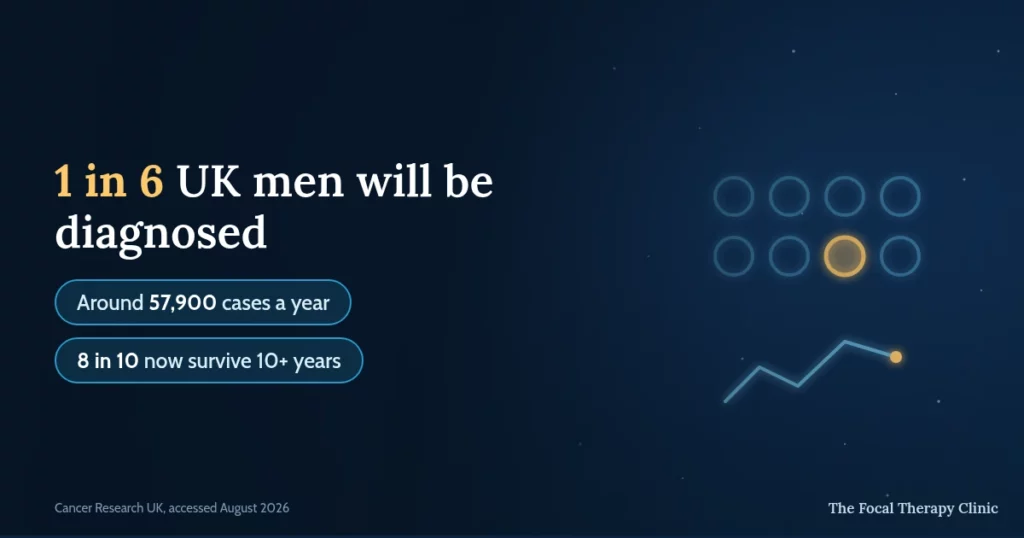
Prostate cancer is the most common cancer in men in the UK, with around 57,900 new cases every year — about 160 every day — and the second most common cancer overall.¹ Around 1 in 6 UK males will be diagnosed in their lifetime, rising to about 1 in 4 for Black men.¹ ² Most diagnoses happen after age 50, and survival has transformed: around 8 in 10 men diagnosed today survive ten years or more, compared with roughly 1 in 5 in the 1970s.¹ Caught early, most men keep every treatment option open — including tissue-preserving focal therapy.
Key takeaways:
- UK incidence — ~57,900 new cases a year; the most common cancer in men and 14% of all new cancer cases (Cancer Research UK).¹
- Lifetime risk — about 1 in 6 UK males overall; about 1 in 4 Black men, who are also diagnosed younger.¹ ²
- Age matters — risk rises strongly after 50; incidence rates peak at ages 75–79 (18% of all new cases).¹
- Survival is high and rising — 78.9% ten-year survival today versus about 1 in 5 in the 1970s; early-stage survival approaches 100%.¹ ³
- Treatment options — localised cancers may be eligible for focal therapy (HIFU, NICE HTG667; NanoKnife IRE, NICE HTG688) to preserve urinary and sexual function.
Prostate cancer incidence in the UK
How many men are diagnosed each year?
A patient urges men to get screened early, describing how a routine PSA test caught his cancer while every treatment option was still open.
Cancer Research UK’s current figures record around 57,900 new prostate cancer cases in the UK every year — around 160 every day.¹
- The most common cancer in men in the UK
- The second most common cancer overall, at 14% of all new cancer cases
- Incidence rates up 54% since the early 1990s¹
Screening and testing context
There is no national screening programme for prostate cancer in the UK. Instead, men can request a PSA test after discussing the benefits and risks with their GP. Awareness campaigns and high-profile diagnoses have encouraged more men to come forward — earlier investigation finds cancers at a stage where more treatment options remain open.
Lifetime risk
Around 1 in 6 UK males will be diagnosed with prostate cancer during their lifetime (Cancer Research UK, based on men born in 1961).¹ You may still see the older “1 in 8” figure quoted — the risk estimate has risen as diagnosis has improved and the population has aged.
More men are also living with and beyond prostate cancer than ever before, because survival has improved substantially over the last two decades. Early-stage cases form a large share of new diagnoses — creating the opportunity for less invasive management that preserves quality of life.
Age, ethnicity and family history
Age
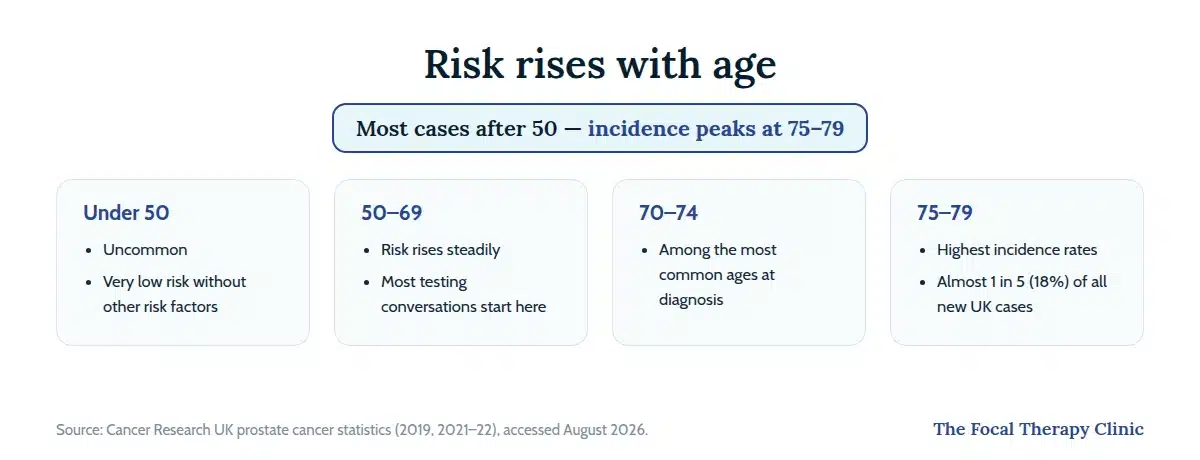
Risk rises sharply with age: most cases occur after 50, and incidence rates peak at ages 75–79, the age group accounting for almost 1 in 5 (18%) of all new cases.¹ Prostate cancer remains uncommon in men under 50.
Ethnicity
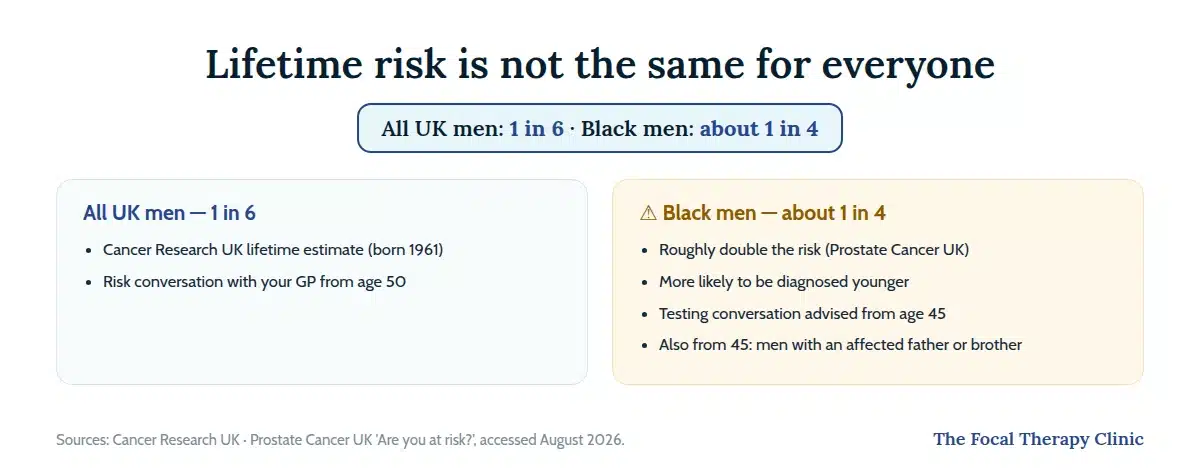
About 1 in 4 Black men in the UK will get prostate cancer in their lifetime — roughly double the risk — and Black men are more likely to be diagnosed at a younger age.² Prostate Cancer UK advises Black men, and men with a family history, to consider a conversation with their GP about testing from age 45 rather than 50.²
Family history
Men with a father or brother diagnosed with prostate cancer are more likely to develop the disease themselves — more so if the relative was diagnosed young. Inherited gene changes (such as BRCA mutations, which also link to breast, ovarian and pancreatic cancer in families) can contribute. Having affected relatives does not mean you will develop prostate cancer, but tell your GP: earlier testing conversations are often advised.
Lifestyle and life expectancy
An ageing population inevitably means more diagnoses of an age-related cancer. No lifestyle change guarantees prevention, but being overweight is associated with a higher risk of advanced prostate cancer — and weight, unlike age or family history, is something you can influence. Sensible steps: a balanced diet rich in vegetables, limited red and processed meat, regular activity, alcohol within NHS limits, and not smoking. Our diet and prostate cancer guide covers the evidence.
Global vs UK comparison
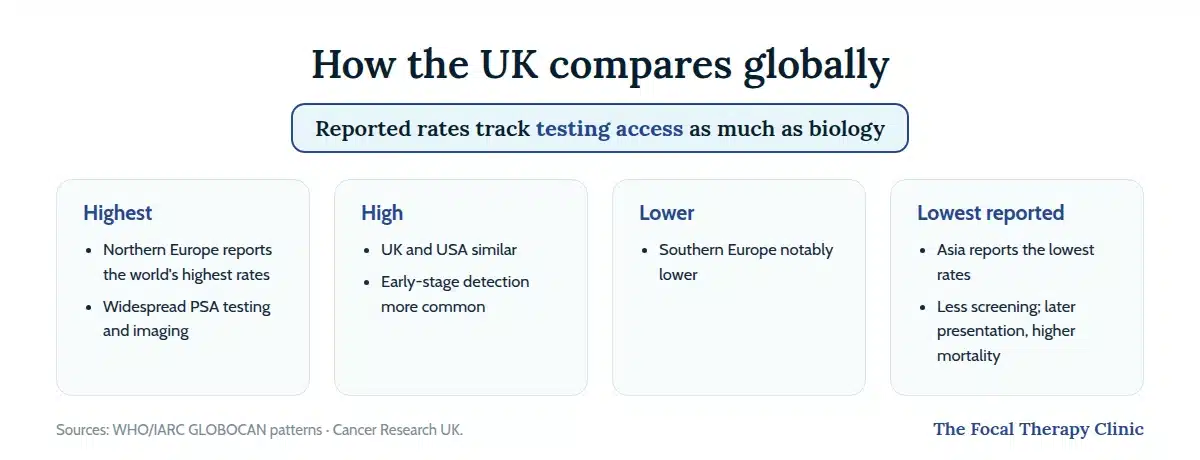
Reported rates vary widely around the world — driven as much by testing access as by underlying biology. Northern Europe reports the highest incidence, with the UK and USA similar and high; Southern Europe is lower, and Asia reports the lowest rates. Widespread PSA testing and advanced imaging raise diagnosis rates in high-income countries, while limited screening in lower-resource settings means fewer diagnoses but later-stage presentation and higher mortality.⁴
Why are the numbers rising?
- An ageing population — risk climbs after 50, so an older demographic means more cases.
- Better detection — MRI visualises suspicious areas accurately, and targeted biopsy finds more clinically significant disease.
- More testing — awareness campaigns and media coverage of high-profile diagnoses have renewed engagement; deprived areas still see later-stage diagnosis than affluent ones.¹
- The trend continues — CRUK projects around 85,100 cases a year in the UK by 2038–40.¹
Get Expert Advice & The Latest Research
Subscribe to our newsletter to receive the latest updates, expert insights, and breakthrough research on prostate cancer-delivered straight to your inbox.
Survival rates and early detection
Mr Marc Laniado explains why early diagnosis of prostate cancer matters — how catching it sooner keeps every treatment option open.
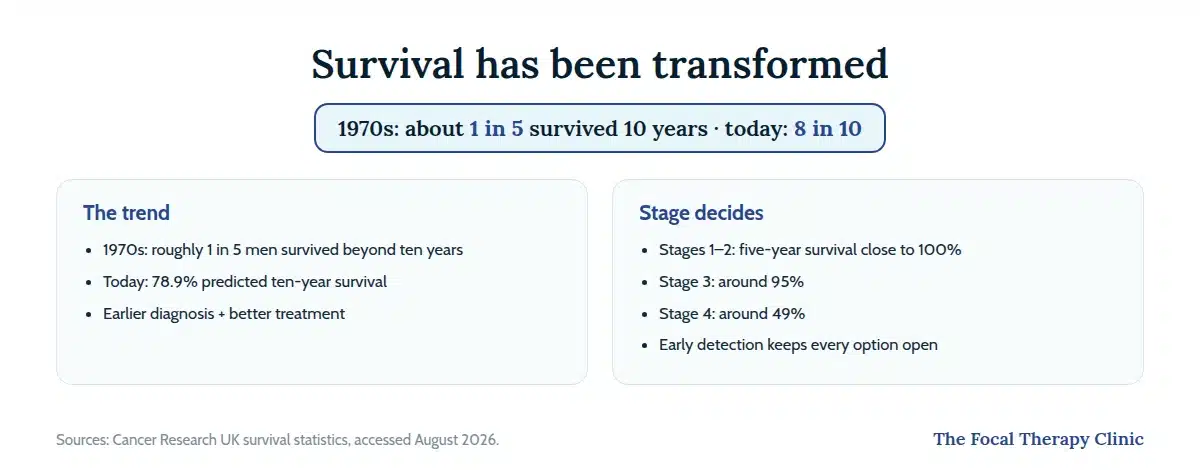
Survival is high and improving: around 8 in 10 men (78.9%) diagnosed with prostate cancer in the UK survive ten years or more — in the 1970s it was roughly 1 in 5.¹ Stage at detection strongly influences prognosis: five-year survival is close to 100% for stages 1–2, around 95% for stage 3, and around 49% for stage 4.³ Our guide to the stages of prostate cancer explains what each stage means.
Symptoms awareness
Early prostate cancer is often silent. When symptoms appear they are usually urinary — difficulty starting, weak or interrupted flow, going more often (especially at night), incomplete emptying, burning, or blood in urine or semen. These are frequently caused by benign conditions such as an enlarged prostate, but they should always be checked rather than watched. Men at higher risk shouldn’t wait for warning signs — discuss testing with a GP.
Focal therapy for common early cases
Many newly diagnosed prostate cancers are confined to the gland, which can make them suitable for targeted treatment. The Focal Therapy Clinic specialises in minimally invasive management of localised disease with HIFU (NICE HTG667) and NanoKnife (NICE HTG688), treating only the cancerous portion of the prostate and preserving healthy tissue.
Our consultants have completed 2,500+ procedures over 75+ years of combined focal therapy experience, at 8 hospital sites across six UK cities. In our audited series of 265 men: 90% cancer-free at one year, 97% maintaining urinary continence, and 90%+ preserving sexual function. Every case is reviewed by a full multidisciplinary team so you get a balanced view of all options — surveillance, surgery, radiotherapy and focal therapy alike.
How can I assess my risk?
Start with the three questions that matter most: your age, your ethnicity, and your family history. If you are over 50 — or over 45 and Black or with an affected father or brother — talk to your GP about whether a PSA test is right for you.² A raised PSA leads to MRI first, and biopsy only where imaging supports it. Our team offers consultations and second opinions at any point in that pathway.
Frequently Asked Questions
Is prostate cancer the most common cancer in the UK?
It is the most common cancer in men, at around 57,900 cases a year. Across the whole population it is the second most common cancer, accounting for 14% of all new cases (Cancer Research UK).¹
What is my lifetime risk of prostate cancer?
Around 1 in 6 UK males will be diagnosed in their lifetime — about 1 in 4 for Black men, who are also diagnosed younger on average.¹ ²
At what age should I start thinking about testing?
There is no screening programme, but from 50 you can request a PSA test after a GP discussion — from 45 if you are Black or have a father or brother with prostate cancer.²
Does more cases mean prostate cancer is getting more dangerous?
No — the rise mainly reflects an ageing population and much better detection. Survival has moved in the opposite direction: from about 1 in 5 surviving ten years in the 1970s to about 8 in 10 today.¹
If I’m diagnosed early, what are my chances?
Excellent: five-year survival for stage 1–2 disease is close to 100%.³ Early diagnosis also keeps the widest range of treatment options open, including function-preserving focal therapy for suitable men.
This content is not intended to be a substitute for professional medical advice, diagnosis, or treatment. Always seek the advice of your urologist or other qualified health provider with any questions you may have regarding a medical condition.
References
- Cancer Research UK. Prostate cancer statistics (incidence, mortality, survival). Accessed August 2026. https://www.cancerresearchuk.org/health-professional/cancer-statistics/statistics-by-cancer-type/prostate-cancer
- Prostate Cancer UK. Are you at risk? Accessed August 2026. https://prostatecanceruk.org/prostate-information-and-support/risk-and-symptoms/are-you-at-risk
- Cancer Research UK. Survival for prostate cancer (by stage). https://www.cancerresearchuk.org/about-cancer/prostate-cancer/survival
- World Health Organization / IARC. GLOBOCAN cancer statistics. https://gco.iarc.fr/