
At a Glance
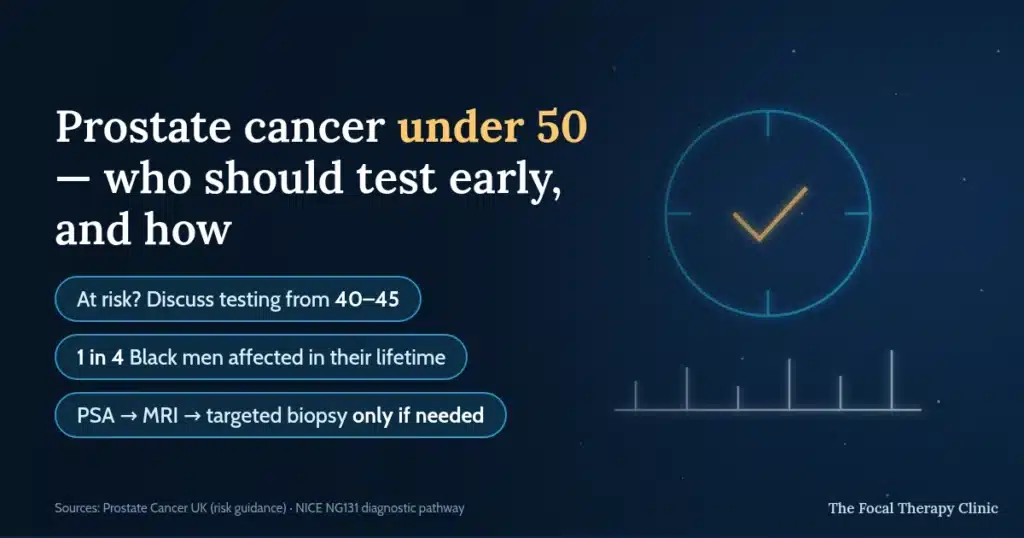
Prostate cancer is often viewed as a condition affecting older generations, yet it is increasingly being identified in men under the age of 50. While less common in this age group, the disease requires specific attention: in younger men it can sometimes be driven by genetic factors that may lead to more aggressive disease. Understanding these risks and the modern diagnostic pathway — PSA, MRI, then targeted biopsy only if needed — is essential for effective treatment and preserving long-term quality of life.
Key takeaways:
- Prostate cancer in men under 50 is less common but often more aggressive, making early detection especially important.
- Men with risk factors — a strong family history, Black, Caribbean or African ancestry, or BRCA mutations — should begin screening discussions as early as age 40–45. Prostate cancer affects 1 in 4 Black men in their lifetime.
- Early-stage cancer is often asymptomatic, making proactive tools like PSA testing vital for at-risk groups.
- The diagnostic pathway typically includes PSA testing, MRI, and biopsy if needed.
- Personalised, minimally invasive options like NICE-approved focal therapy (HIFU, HTG667; NanoKnife IRE, HTG688) help preserve urinary and sexual function — with 90%+ of men maintaining sexual function.
- A multidisciplinary team (MDT) is important for evaluating cases in younger patients.
Understanding prostate cancer in younger men
Mr Alan Doherty answers whether young men can get prostate cancer — why it is less common under 50 but does happen, and why symptoms and risk factors still warrant a check.
The risk of prostate cancer in young men under 50 is distinct from that in older demographics. While the overall incidence is lower, cases in this age group are more likely to have a genetic component. Research suggests that when metastatic disease does occur in younger men, it can impact life expectancy significantly, highlighting the absolute necessity of timely detection.²·³
“Localised prostate cancer” describes cancer confined within the gland, whereas “metastasis” means it has spread to other parts of the body, such as the bones. Fortunately, medical technology has evolved. This supports treatment options that prioritise functional preservation — a critical factor for younger men who may otherwise face decades of side effects.
Risk factors and who should be concerned
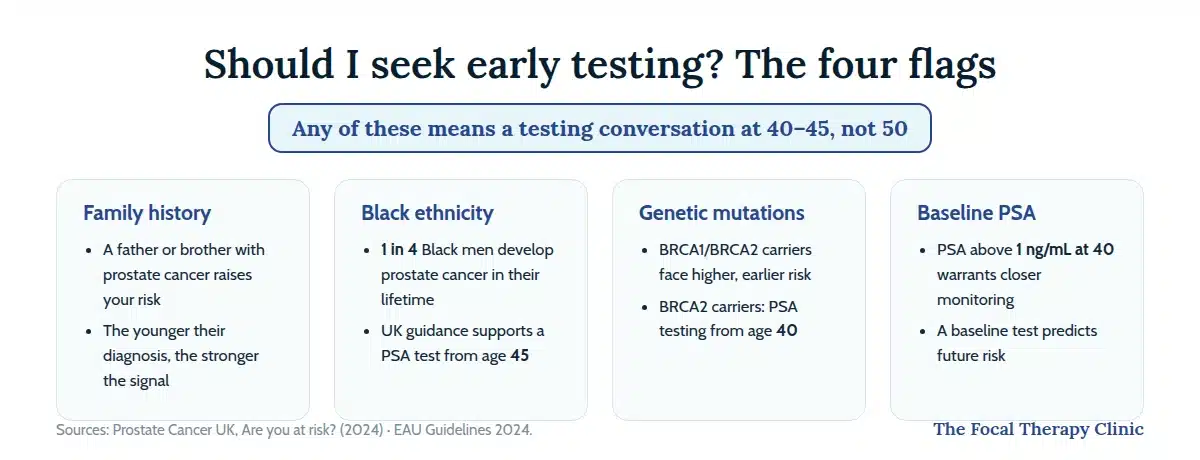
Specific biological factors increase the likelihood of early-onset prostate cancer. Men with these profiles should not wait for national screening ages but instead seek early advice. Key factors include a strong family history, Black, Caribbean or African ancestry, and inherited genetic markers like BRCA1 and BRCA2 mutations. Prostate cancer affects 1 in 4 Black men in their lifetime — double the overall risk — and UK guidance supports Black men requesting a PSA test from age 45.⁴
A “germline mutation” is a DNA change inherited from a parent, present in every cell of the body. These mutations can increase susceptibility to various cancers. Being aware of this inherited risk allows for a personalised screening schedule, often starting between ages 40 and 45.
Prostate cancer risk factors and suggested baseline testing:
| Risk factor | Suggested discussion age |
|---|---|
| Family history of prostate cancer | 40–45 |
| Black, Caribbean or African ancestry | 40–45 |
| Known genetic mutations (e.g. BRCA2) | 40–45 |
| PSA >1 ng/mL at age 40 | Monitor closely |
Early signs and symptoms to watch for
It is important to recognise that early prostate cancer is frequently asymptomatic. In men under 50, a diagnosis often comes from investigating unrelated issues or through proactive health checks.
However, when early symptoms do appear, they should never be ignored. Warning signs can include difficulty starting urination, a weak flow, blood in the urine or semen, or unexplained pelvic pain. While these can also be caused by benign conditions, in younger men they warrant a thorough check to rule out malignancy.
The testing process for men under 50
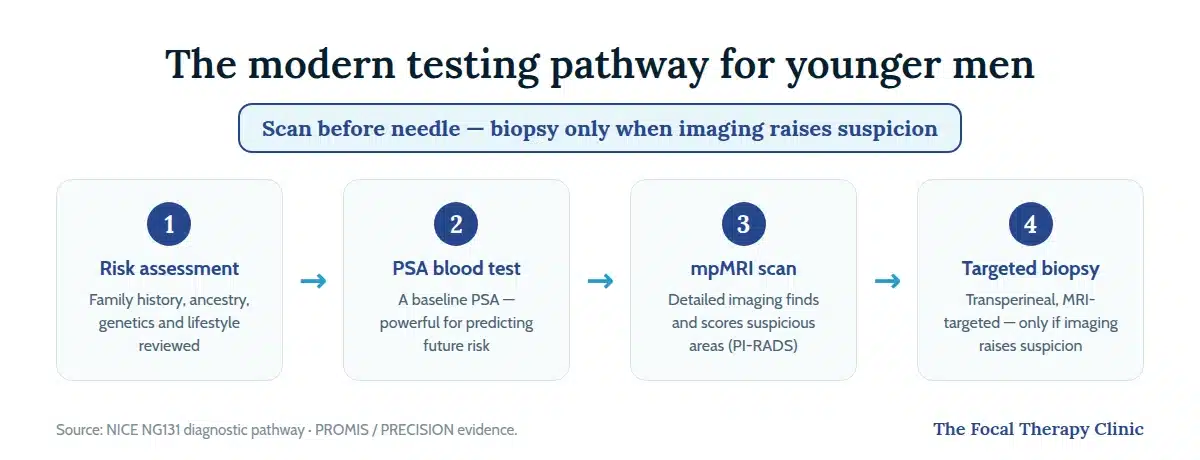
This process begins with a risk assessment, followed by blood tests and physical exams. If these initial steps raise concerns, advanced imaging is used before any invasive procedures.
Key steps in the process include:
- Initial risk assessment based on family history, genetic and lifestyle factors
- Prostate-specific antigen (PSA) blood testing
- MRI (mpMRI or bpMRI) if results from initial tests are inconclusive or concerning
- Prostate biopsy to confirm diagnosis if imaging raises suspicion
Prostate-Specific Antigen (PSA) testing
The PSA test measures a protein produced by the prostate. While high levels can indicate cancer, they can also be caused by infection or benign enlargement. In men under 50, a baseline PSA test is a powerful tool for predicting future risk.
A PSA level above 3–4 ng/mL often prompts further investigation, but in younger men, even lower thresholds may trigger monitoring if other risk factors are present.
Advanced imaging with MRI
Multiparametric MRI (mpMRI) is an imaging technique that combines T2-weighted, diffusion-weighted, and contrast-enhanced sequences to assess prostate abnormalities. It provides detailed information that helps clinicians determine whether a biopsy is necessary and where to target it. mpMRI has significantly improved risk stratification and diagnostic accuracy.
Standardised scoring systems like PI-RADS and Likert are used to assess the likelihood of clinically significant cancer. Other imaging modalities such as biparametric MRI, mpUS, or PSMA PET/CT may also be considered based on patient profile — see our guide to MRI scans for prostate cancer.
Confirming diagnosis through biopsy and genetic testing
If risk assessment and imaging suggest cancer, a biopsy provides final confirmation. The modern standard is the transperineal biopsy, where needles are passed through the skin rather than the rectum, lowering the risk of infection.
For younger men, confirming the diagnosis also opens the door to further genetic testing. Understanding the genetic drivers of the tumour can influence treatment choices and provide information for family members regarding their own risk.
Assessing cancer risk and aggressiveness
Not all prostate cancers need immediate radical treatment. Clinicians use the Gleason score (or ISUP Grade Group) to determine how aggressive the cells are.
- Low risk: the cancer grows very slowly and may not cause problems for many years to decades.
- Intermediate/High risk: the cancer is likely to grow or spread and requires treatment.
For men under 50, correctly identifying the type of prostate cancer is vital. It prevents the overtreatment of harmless disease while ensuring aggressive cancers are managed effectively.
Get Expert Advice & The Latest Research
Subscribe to our newsletter to receive the latest updates, expert insights, and breakthrough research on prostate cancer-delivered straight to your inbox.
The role of multidisciplinary evaluation in diagnosis
A diagnosis in a young man is complex, balancing cancer control with decades of future life. This requires an MDT — a group of urologists, oncologists, radiologists, and pathologists reviewing the case together.
At The Focal Therapy Clinic, our GMC-registered consultant urologists, radiologists and oncologists work within a multidisciplinary team, ensuring patients are offered the full range of modern options. With more than 2,500 focal therapy procedures performed across 8 hospital sites in six UK cities, we use advanced MRI-fusion diagnostic technology to determine suitability for NICE-approved precision treatments that spare healthy tissue.
What to expect after diagnosis: follow-up and monitoring
For some younger men with low-risk disease, active surveillance is usually the recommended path. This involves regular MRI scans and PSA tests to monitor the cancer without immediate treatment.
Living with prostate cancer on surveillance requires commitment to follow-up schedules. Lifestyle factors, such as diet and exercise, play a supportive role here. If the disease shows signs of progression, the plan can be switched to intervention.
The importance of early and accurate diagnosis in younger men
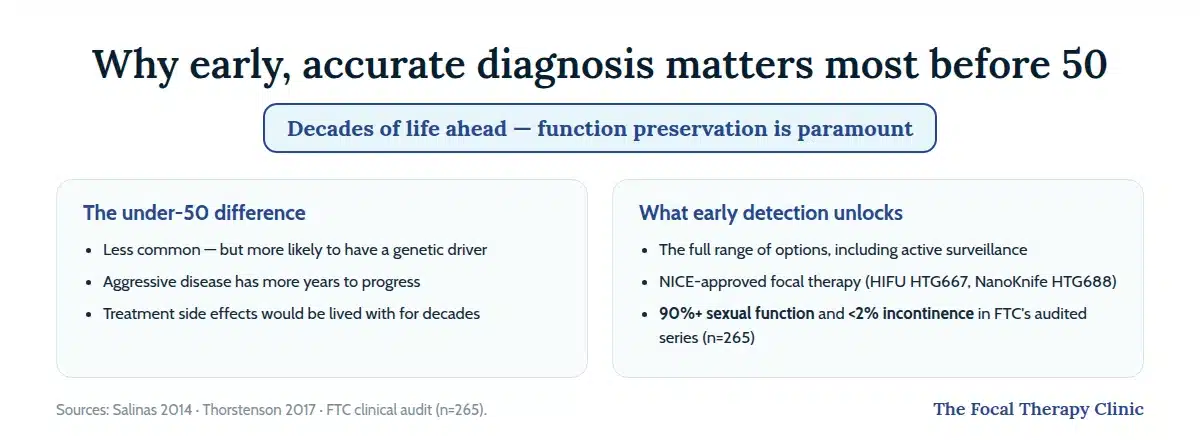
Timely diagnosis is the cornerstone of successful outcomes. While often considered an old man’s disease, prostate cancer in younger men requires a specific strategy.
Early detection allows for the use of therapies that minimise collateral damage. In The Focal Therapy Clinic’s audited series of 265 men, 90%+ maintained sexual function and fewer than 2% experienced urinary incontinence — priorities that are often paramount for men under 50 who have many decades of life ahead.
Frequently asked questions
When should men under 50 start prostate cancer testing?
Men with a known genetic mutation (BRCA2) should start PSA testing at 40. Those with a family history or Black ancestry are advised to begin discussions at 45. For others, testing is typically considered from age 50, but individual concerns should always be discussed with a GP.
What tests are most effective for younger men?
A baseline PSA test combined with a risk assessment, including family history, is the most effective starting point. If PSA is elevated, an MRI is the gold standard for visualising potential cancer before any invasive biopsy is performed.
Why is early detection crucial for men under 50?
Younger men have a longer life expectancy, meaning they have more years to benefit from a cure but also more years to live with potential side effects. Early detection often allows for less invasive treatments, such as focal therapy, that strike a better balance between cure and quality of life.
Should men without symptoms still consider screening?
Yes, if they are in a high-risk category. Early-stage prostate cancer rarely causes symptoms. Waiting for urinary problems to appear can sometimes result in the window for early, curative treatment being missed.
How is prostate cancer in younger men different from older patients?
It is more likely to have a genetic component. While treatment principles are similar, the decision-making process for younger men places a heavier weight on preserving sexual and urinary function for the long term.
This content is not intended to be a substitute for professional medical advice, diagnosis, or treatment. Always seek the advice of your urologist or other qualified health provider with any questions you may have regarding a medical condition.
References
- European Association of Urology. EAU Guidelines on Prostate Cancer. 2024. https://uroweb.org/guidelines/prostate-cancer
- Salinas CA, Tsodikov A, Ishak-Howard M, Cooney KA. Prostate cancer in young men: an important clinical entity. Nat Rev Urol. 2014;11(6):317–323.
- Thorstenson A, Garmo H, Adolfsson J, Bratt O. Cancer Specific Mortality in Men Diagnosed with Prostate Cancer before Age 50 Years: A Nationwide Population Based Study. J Urol. 2017;197(1):61–66. doi:10.1016/j.juro.2016.06.080
- Prostate Cancer UK. Are you at risk? 2024. https://prostatecanceruk.org/prostate-information-and-support/risk-and-symptoms/are-you-at-risk