
At a Glance
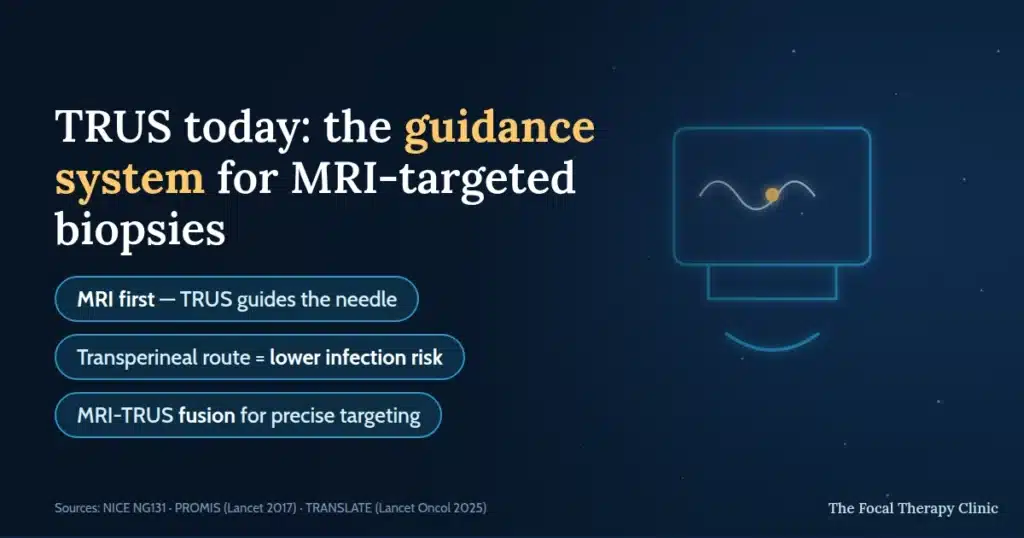
The role of the transrectal ultrasound scan (TRUS) in prostate cancer care has evolved. Once a primary investigative tool, today it serves as an important real-time guidance system for performing precise, MRI-led prostate biopsies — the modern standard of care.
Key takeaways:
- The primary imaging test for suspected prostate cancer is now multiparametric MRI (mpMRI). TRUS is a tool used to guide the biopsy needles accurately based on the MRI findings.
- A TRUS probe guides the biopsy, which should be performed via the transperineal route (through the skin) as it has a lower risk of infection than the transrectal route.
- MRI-TRUS fusion overlays the detailed MRI map onto the live TRUS image, allowing for precise targeting during a biopsy.
- As a standalone imaging tool, TRUS has a poorer detection rate for significant prostate cancer compared to the current standard of care, mpMRI.
What is a transrectal ultrasound scan (TRUS)?
Mr Tim Dudderidge explains what a transrectal biopsy is and how it samples the prostate under ultrasound guidance.
A TRUS is an imaging procedure using a small ultrasound probe, gently inserted into the rectum. The probe emits high-frequency sound waves that reflect off the prostate gland nearby, creating a live image on a screen. This allows clinicians to measure prostate volume and guide instruments like biopsy needles with precision.
The evolving role of TRUS in prostate diagnosis
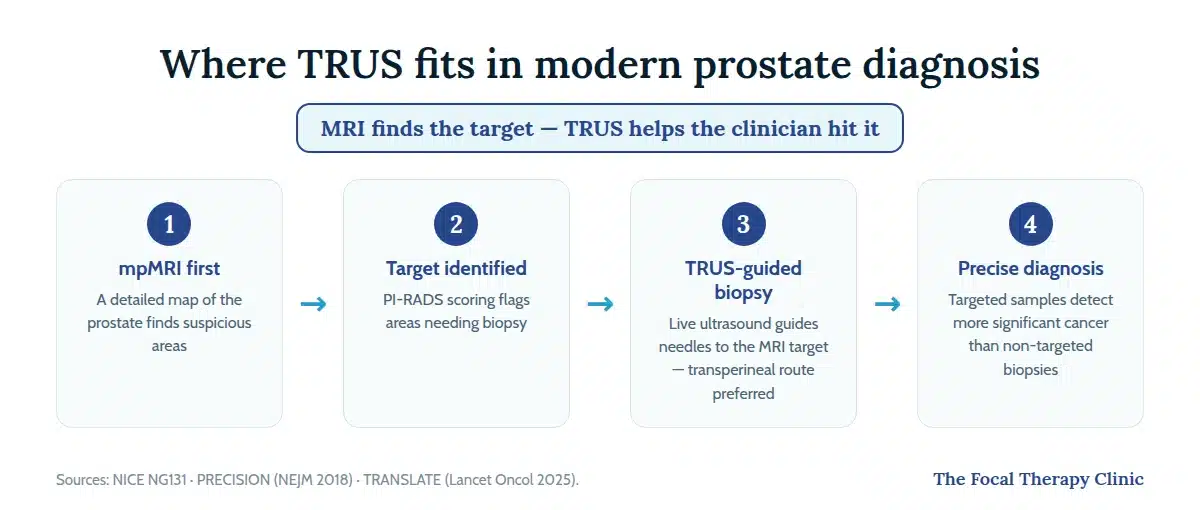
The diagnostic pathway for prostate cancer has transformed. The previous approach of performing a systematic, non-targeted TRUS biopsy after a raised PSA level has been replaced by a more accurate, MRI-first pathway.¹·² The current NICE-recommended pathway is to perform a detailed mpMRI scan first.³ If this shows a suspicious area, a targeted biopsy is then performed. The TRUS probe provides the live imaging needed to guide the needle to the MRI-defined target. TRUS has therefore shifted from a speculative diagnostic tool to a precise procedural guidance system.
What to expect during a TRUS procedure
A TRUS-guided biopsy is typically an outpatient procedure where you lie on your side with your knees drawn up. A local anaesthetic is used to numb the area — either a gel in the rectum for a transrectal biopsy or an injection in the skin for a transperineal biopsy.
The urologist gently inserts the lubricated TRUS probe and uses it to guide a fine needle to take small tissue samples. The procedure typically takes 15–20 minutes.
Are there any risks or limitations?
While a TRUS-guided biopsy is generally safe, it has risks and limitations.
Limitations:
- The primary limitation is that TRUS imaging on its own offers poor diagnostic accuracy.
- MRI-targeted biopsy detects much more clinically significant prostate cancer than a non-targeted systematic TRUS biopsy.²·⁷
Risks:
- One of the most serious risks is infection — shown to be reduced via the transperineal approach compared to the transrectal route.⁶
- It is common to see a small amount of blood in the urine, semen, and bowel movements for a short time.
- Some men may experience temporary difficulty passing urine.
TRUS vs. MRI vs. PSMA PET Scan
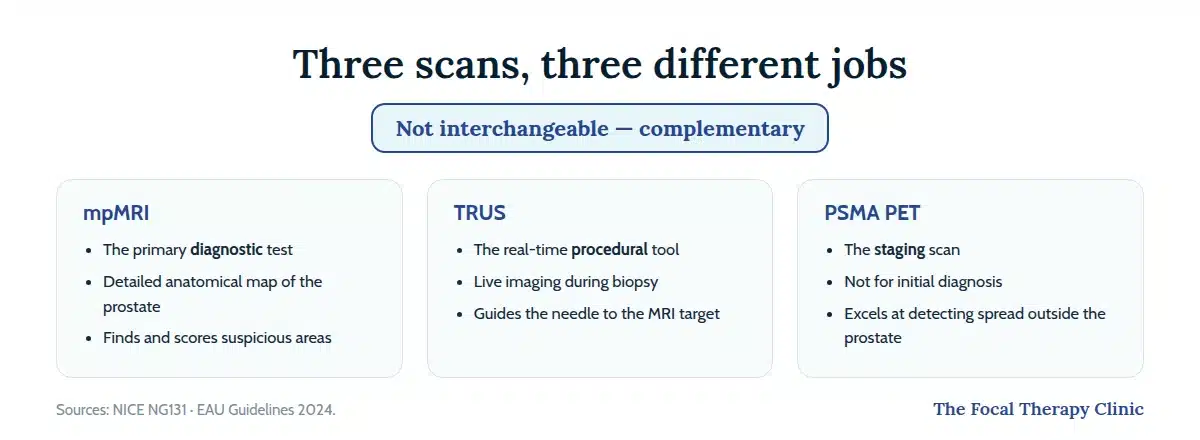
These scans serve different, complementary purposes and are not interchangeable.
- MRI scans: the primary diagnostic imaging test. It provides a detailed anatomical “map” of the prostate to find suspicious areas.
- TRUS: the real-time procedural tool. It provides live imaging to help the clinician guide the biopsy needle to the targets identified on the MRI map.
- PSMA PET: a highly advanced scan used for staging cancer, not initial diagnosis. A PSMA scan excels at detecting whether cancer has spread outside the prostate.
At The Focal Therapy Clinic, our expert clinicians use advanced MRI-TRUS fusion systems, merging the MRI map with the live TRUS image to ensure more accurate biopsies. In our internal audit of MRI-ultrasound fusion targeted biopsies over the last 36 months (881 patients), a second expert review of every MRI found areas of concern on MRI review in 40.4% of patients and identified clinically significant lesions in overall 16% of patients — precision that a non-targeted biopsy simply cannot match.
Get Expert Advice & The Latest Research
Subscribe to our newsletter to receive the latest updates, expert insights, and breakthrough research on prostate cancer-delivered straight to your inbox.
TRUS in the focal therapy patient journey
For men considering focal therapy, an accurate diagnosis is paramount. The treatment relies on a detailed map of the cancer to allow for precise ablation, aiming to preserve healthy tissue and function. The modern diagnostic pathway — an MRI to detect, followed by a TRUS-guided biopsy to confirm — provides this. This diagnosis is the bedrock upon which our expert clinicians build a personalised, function-preserving treatment plan.
Conclusion
TRUS enables the highly accurate, MRI-targeted biopsies that are now the standard of care. Understanding its modern role empowers men to have informed discussions about their health and appreciate the precision that underpins advanced treatments like focal therapy.
Frequently Asked Questions
Do I need a TRUS scan before focal therapy?
Yes, a TRUS scan is usually recommended as part of the assessment before focal therapy. It helps ensure accurate biopsies and plays a role in personalised treatment planning. TRUS is often used alongside MRI scans to give a complete picture of the prostate before treatment begins.
What is a transrectal ultrasound scan used for?
In modern prostate cancer diagnosis, a TRUS is used to measure prostate volume and to provide live imaging to guide needles during an MRI-targeted biopsy. Its role as a standalone tool for detecting cancer has been superseded by the more accurate mpMRI scan in the modern diagnostic pathway.
Is a TRUS scan painful?
A TRUS scan itself is usually not painful, though it can cause a feeling of pressure. When used for a biopsy, a local anaesthetic is given to minimise pain. The transperineal approach, now preferred, is generally very well tolerated.
How accurate is a TRUS in detecting prostate cancer?
On its own, TRUS imaging is not accurate for detecting significant prostate cancer. However, when used to guide an MRI-targeted biopsy (MRI-TRUS fusion), the accuracy of the procedure is very high, detecting more significant cancers than older, non-targeted methods.
What is the difference between TRUS and MRI?
An mpMRI scan uses magnetic fields to create a detailed “map” of the prostate to find suspicious areas. TRUS uses sound waves to create a live image to guide a biopsy needle to that target in real time. In short: MRI finds the target, and TRUS helps the clinician hit it.
This content is not intended to be a substitute for professional medical advice, diagnosis, or treatment. Always seek the advice of your urologist or other qualified health provider with any questions you may have regarding a medical condition.
References
- Ahmed HU, El-Shater Bosaily A, Brown LC, et al. Diagnostic accuracy of multi-parametric MRI and TRUS biopsy in prostate cancer (PROMIS): a paired validating confirmatory study. Lancet. 2017;389(10071):815–822. doi:10.1016/S0140-6736(16)32401-1
- Kasivisvanathan V, Rannikko AS, Borghi M, et al. MRI-Targeted or Standard Biopsy for Prostate-Cancer Diagnosis (PRECISION). N Engl J Med. 2018;378(19):1767–1777. doi:10.1056/NEJMoa1801993
- National Institute for Health and Care Excellence. Prostate cancer: diagnosis and management (NG131). 2019, updated 2021. https://www.nice.org.uk/guidance/ng131
- European Association of Urology. EAU Guidelines on Prostate Cancer. 2024. https://uroweb.org/guidelines/prostate-cancer
- Cancer Research UK. Transrectal ultrasound scan (TRUS) and biopsy for prostate cancer. 2025. https://www.cancerresearchuk.org/about-cancer/tests-and-scans/transrectal-ultrasound-guided-trus-biopsy
- Bryant RJ, Marian IR, Williams R, et al. Local anaesthetic transperineal biopsy versus transrectal prostate biopsy in prostate cancer detection (TRANSLATE): a multicentre, randomised, controlled trial. Lancet Oncol. 2025;26(5):583–595. doi:10.1016/S1470-2045(25)00100-7
- Kasivisvanathan V, Stabile A, Neves JB, et al. Magnetic Resonance Imaging-targeted Biopsy Versus Systematic Biopsy in the Detection of Prostate Cancer: A Systematic Review and Meta-analysis. Eur Urol. 2019;76(3):284–303. doi:10.1016/j.eururo.2019.04.043