

At a Glance
Men diagnosed with prostate cancer often face real anxiety about the timing of their care. Delays cause worry and can affect outcomes — but understanding your diagnosis, consulting a specialist early, and actively managing your scheduling can all shorten the path. The most important principle: securing the right treatment matters more than securing the fastest one. Accurate staging with multiparametric MRI (and PSMA PET where indicated) ensures that when you do get a slot, it is for the correct procedure.
Key takeaways:
- Know your numbers — stage, Gleason score/Grade Group and PSA level guide the urgency and type of care.
- See a specialist early — early consultation reduces delays and widens treatment access; second opinions clarify options.
- Focal therapy for suitable men — minimally invasive treatment that preserved continence in 97% and sexual function in 90%+ of men in FTC’s audit (n=265).
- Accurate diagnostics first — multiparametric MRI and PSMA PET support the right decision, not just the quickest one.
- Be proactive — organised records, direct contact with clinics, and fast-track requests genuinely speed things up.
Understand your prostate cancer diagnosis
A significant proportion of men with low-risk prostate cancer can be managed with active surveillance — regular monitoring rather than immediate intervention, avoiding side effects while the cancer remains indolent.¹
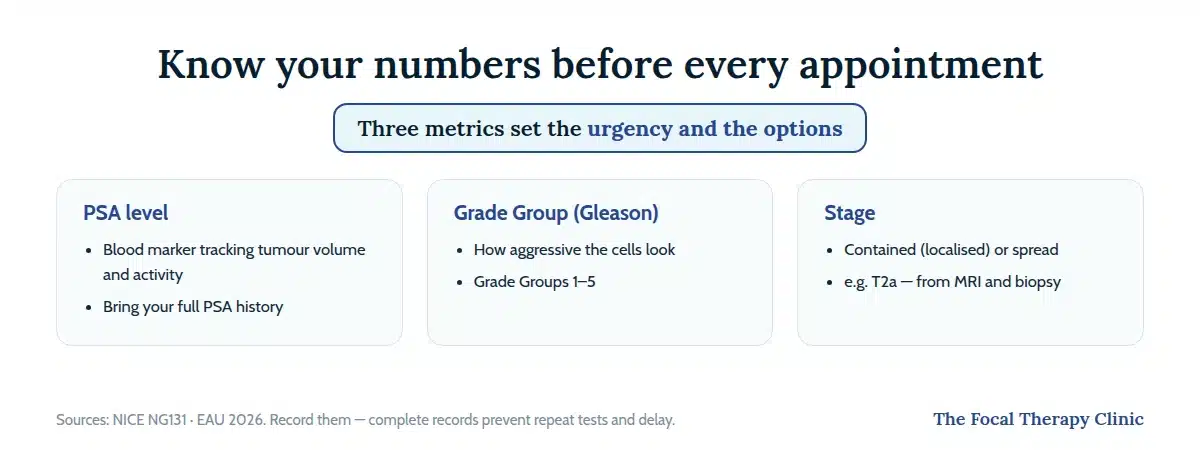
For those needing treatment, three metrics guide urgency and type:
- Stage — whether the cancer is contained within the prostate (localised) or has spread (see our stages guide)
- Gleason score / Grade Group — how aggressive the cells look
- PSA level — a blood marker that correlates with tumour volume and activity
Record these details before every appointment. Age alone should not be an automatic barrier to care — fitness matters more than birth year.
Checklist for your consultation: current PSA ______ · Grade Group ______ · stage (e.g. T2a) ______
Consult a prostate cancer specialist
Mr Marc Laniado walks through what happens at a Focal Therapy Clinic consultation — what is reviewed, and how treatment decisions are reached with each patient.
Seeing a specialist early speeds up your treatment path. NHS and private routes both work; private clinics often offer faster appointments. Find a specialist through your GP, clinic websites or professional networks — and favour centres with genuine multidisciplinary teams (urologists, oncologists, radiologists) — like our consultant team.
The Focal Therapy Clinic provides detailed second opinions on treatment options — especially useful if you’re unsure about next steps, and often the fastest way to understand whether your current plan fits your cancer and priorities.
Explore available treatment options
The modern treatment landscape includes minimally invasive focal techniques, robotic surgery, newer hormone therapies and targeted drugs. The right option depends on your cancer profile, goals and preferences — and specialist centres often offer quicker access to newer treatments. Make sure you understand all the treatment options available to you before committing.
Minimally invasive focal therapy techniques
Focal therapy treats only the cancerous area while preserving healthy tissue — using energy sources such as focused ultrasound (HIFU), freezing (cryotherapy) or electrical pulses (IRE). Faster recovery and fewer long-term problems are the goal, for men with early-stage, localised, MRI-visible disease.
At The Focal Therapy Clinic, patients are treated with HIFU (NICE HTG667) or NanoKnife (NICE HTG688) using advanced MRI-ultrasound fusion guidance. In our audited series of 265 men, 97% maintained urinary continence and 90%+ preserved sexual function, with 90% cancer-free at one year. Suitability depends on cancer location, stage and overall health — and structured follow-up afterwards is essential.
Surgery and radiotherapy options
Whole-gland treatments remain widely used. Robotic-assisted radical prostatectomy is minimally invasive with typically short hospital stays, for localised tumours. Radiotherapy — external beam or brachytherapy — suits localised and locally advanced disease, and men not fit for surgery.
Surgery involves longer recovery and higher functional risk than focal approaches; radiotherapy carries bowel and urinary risks of its own. Compare honestly — our side-effects guide sets the treatments side by side.
Hormone therapy and emerging treatments
For locally advanced or metastatic disease, systemic treatment is required: hormone therapy (ADT) is the cornerstone, with newer options — PSMA-targeted radioligand therapy among them — transforming care for advanced cases. If you’re concerned about disease returning, our guide to where prostate cancer spreads explains monitoring and salvage options.
Get Expert Advice & The Latest Research
Subscribe to our newsletter to receive the latest updates, expert insights, and breakthrough research on prostate cancer-delivered straight to your inbox.
Use advanced diagnostics to inform treatment timing
Speed should never cost accuracy. Multiparametric MRI visualises significant cancer and can spare men unnecessary biopsies; PSMA PET sharpens staging in higher-risk cases. Accurate staging prevents both under-treatment (missing aggressive disease) and over-treatment (treating indolent disease) — so the slot you secure is for the right procedure.¹
Actively manage your treatment scheduling
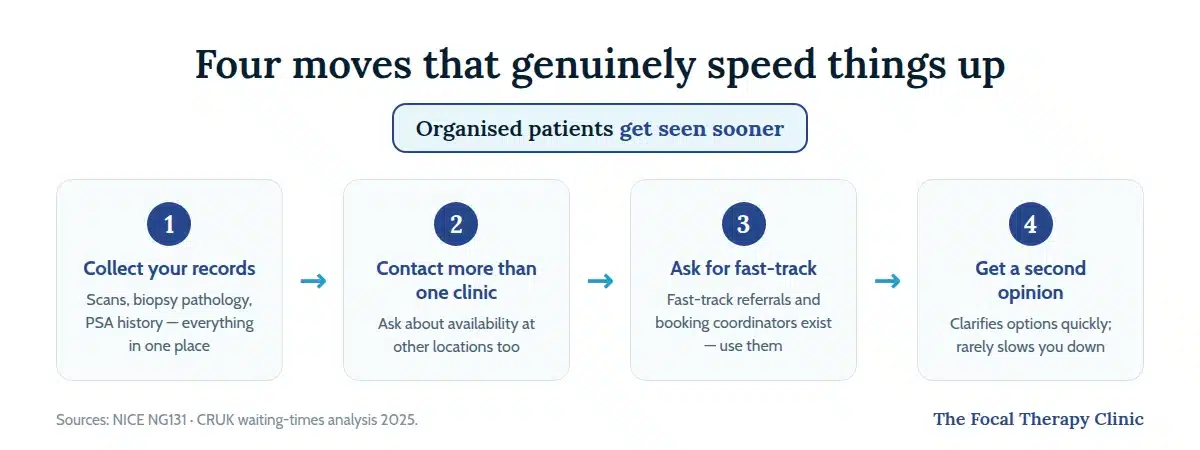
Take control of the timeline:
- Collect all medical records — scans, biopsy reports, PSA history
- Contact more than one clinic — and ask about availability at other locations
- Ask for fast-track referrals — and use booking coordinators where offered
- Request second opinions — they clarify options and rarely slow you down
Cancer waiting-time pressures in the NHS are well documented;² being organised and proactive is the single most effective patient-side lever.
Where you live shapes your options too — men in Scotland should read about focal therapy as an alternative to radical treatment in Scotland.
Stay updated on treatment advances
Treatments evolve quickly and guidelines update constantly (NICE, EAU).¹ ³ Follow trusted sources such as Prostate Cancer UK and Cancer Research UK, and — if you have focal therapy — understand the monitoring protocol that follows, so long-term peace of mind is built into the plan.
Frequently Asked Questions
How quickly should prostate cancer be treated after diagnosis?
It depends on risk. Low-risk cancers can safely be monitored; higher-risk disease warrants prompt treatment. Your Grade Group, PSA and stage set the clock — a specialist can tell you what “soon enough” means in your case.
Is going private always faster?
Often for the first consultation and diagnostics, yes. Some men use a private consultation and imaging to accelerate decisions, then choose where to be treated. Weigh cost, continuity and your clinical picture — see our fees page.
What should I bring to a first specialist appointment?
PSA history, MRI report and images, biopsy pathology, current medications and a written list of questions. Complete records prevent repeat tests — often the biggest hidden delay.
Will a second opinion delay my treatment?
Rarely — and it can prevent the much bigger delay of the wrong first treatment. Reviews can usually be arranged quickly with your existing scans and reports.
Can I switch hospitals to be treated sooner?
Yes — you can ask your team or GP about availability elsewhere, in the NHS or privately. Treatment at 8 hospital sites across six UK cities is one reason FTC can often offer earlier dates.
This content is not intended to be a substitute for professional medical advice, diagnosis, or treatment. Always seek the advice of your urologist or other qualified health provider with any questions you may have regarding a medical condition.
References
- National Institute for Health and Care Excellence. Prostate cancer: diagnosis and management (NG131). 2019, updated 2021. https://www.nice.org.uk/guidance/ng131
- Cancer Research UK. Cancer waiting times: latest updates and analysis. 2025. https://news.cancerresearchuk.org/2025/12/11/cancer-waiting-times-latest-updates-and-analysis/
- European Association of Urology. EAU Guidelines on Prostate Cancer. 2026. https://uroweb.org/guidelines/prostate-cancer
- Prostate Cancer UK. Active surveillance. 2023. https://prostatecanceruk.org/prostate-information-and-support/treatments/active-surveillance