
At a Glance
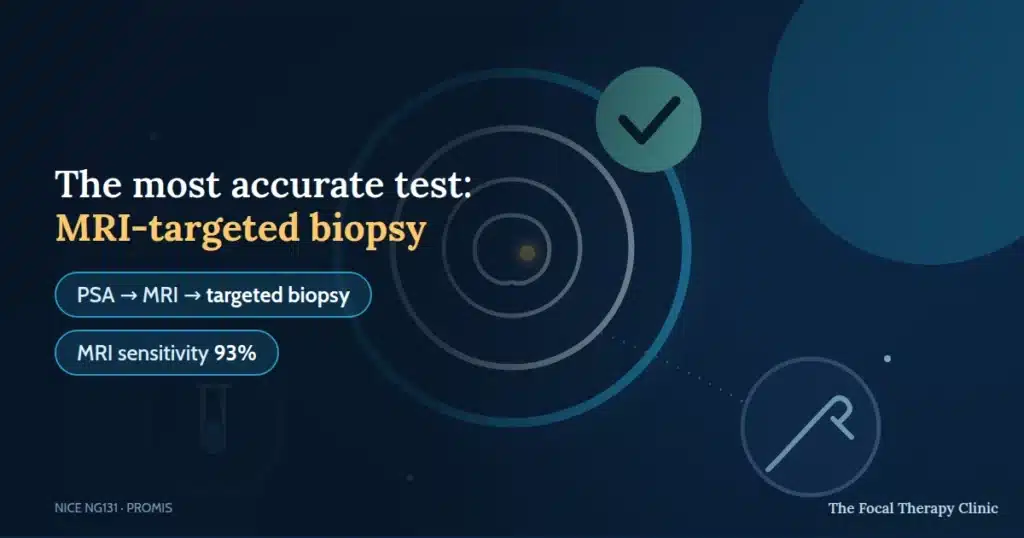
An MRI-targeted biopsy is the most accurate single test for diagnosing prostate cancer. NICE NG131 sets a stepped pathway: PSA first, then multiparametric MRI, then targeted biopsy only when imaging shows a suspicious area. In the PRECISION trial, MRI-targeted biopsy found 12% more clinically significant cancers than systematic biopsy.
Key takeaways:
- PSA starts the process — it never ends it — raised results are also caused by benign enlargement, infection and inflammation.
- MRI decides who needs a biopsy — the PROMIS trial found 93% sensitivity for clinically significant cancer; a clear scan can spare some men a biopsy.
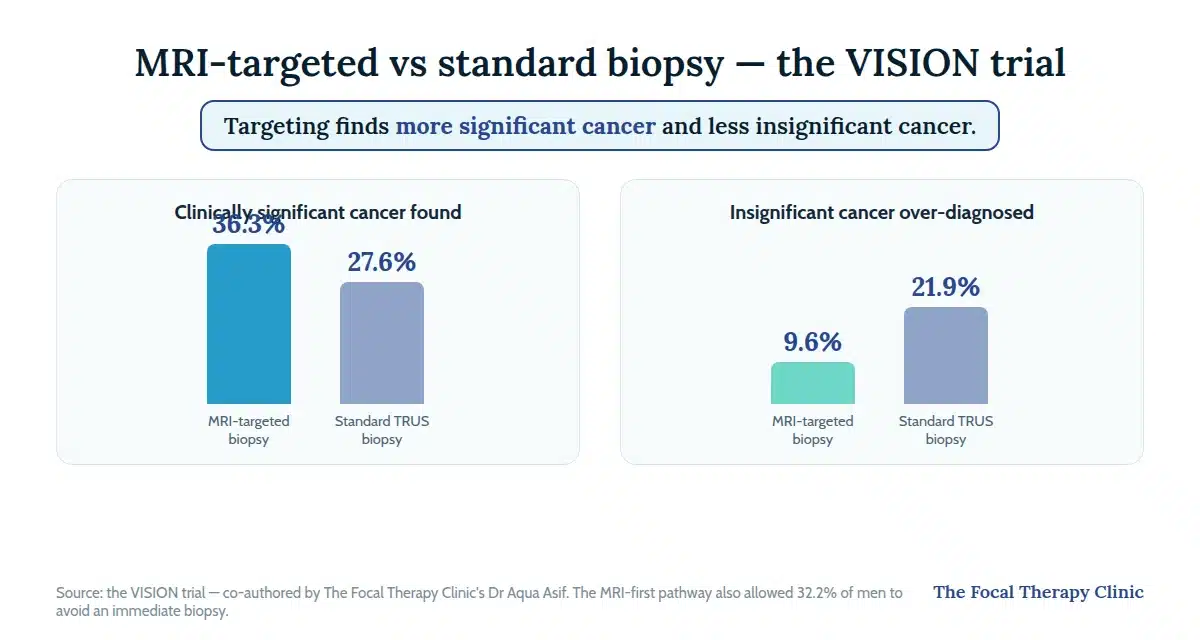
- Targeted beats systematic — the VISION trial, co-authored by our own Dr Aqua Asif, found MRI-targeted biopsy detected clinically significant cancer in 36.3% of men versus 27.6% with standard TRUS biopsy.
- Transperineal is the safer route — it avoids the rectal wall and carries a lower infection risk.
- Second-read MRI adds real accuracy — in our internal audit of 881 patients, specialist second review found areas of concern on MRI review in 40.4% of patients and identified clinically significant lesions in 16% overall.
An MRI-targeted biopsy is currently the most accurate single test for diagnosing prostate cancer. NICE guideline NG131 supports a stepped pathway of PSA assessment, followed by multiparametric MRI, followed by targeted biopsy when MRI shows a suspicious area. The PRECISION trial found MRI-targeted biopsy detects 12% more clinically significant cancers than systematic biopsy.
Quick Answer: Which Prostate Cancer Test Is Most Accurate?
MRI-targeted biopsy is the most accurate single diagnostic test for confirming prostate cancer when mpMRI has found a suspicious area. The best test for prostate cancer depends on where a man is in the diagnostic pathway. PSA helps start the process, mpMRI helps locate suspicious areas, and biopsy confirms whether cancer is present.
| Test | Accuracy Role | NICE Recommendation |
|---|---|---|
| PSA | Useful first blood test, but not diagnostic on its own | Used to assess risk and guide referral decisions |
| mpMRI | Strong imaging test that can identify suspicious areas and help some men avoid biopsy | Recommended as first-line investigation before biopsy for suspected clinically localised prostate cancer |
| MRI-targeted biopsy | Most accurate single test for confirming prostate cancer diagnosis | Recommended when mpMRI shows a suspicious area |
| Digital rectal exam | Can detect some hard or irregular prostate areas, but has limited accuracy | Used as part of clinical assessment, not as a standalone diagnostic |
Key takeaways:
- MRI-targeted biopsy is the most accurate diagnostic method because it samples suspicious areas found on mpMRI.
- PSA is a starting point, but a raised result can also be caused by infection, inflammation, or benign prostate enlargement.
- NICE guideline NG131 recommends mpMRI before biopsy for men with suspected clinically localised prostate cancer.
- Early detection matters because men diagnosed with localised disease may have more treatment options, including focal therapy.
- The usual stepped pathway is PSA, clinical assessment, mpMRI, then targeted biopsy only when needed.
Why Early Detection of Prostate Cancer Matters
A patient urges men to get screened early, describing how a routine PSA test caught his cancer while every treatment option was still open.
Early detection matters because it gives men more time and more choice. Men diagnosed with localised prostate cancer often have the widest range of treatment options, including tissue-preserving treatments such as focal therapy. There is no national screening programme for prostate cancer in the UK. NICE NG131 sets out a clear diagnostic pathway for men with suspected clinically localised disease, making testing for prostate cancer UK a guided process rather than one single test for every man.
Common Symptoms and Risk Factors
Early prostate cancer typically causes no symptoms, which is why testing discussions matter even for men who feel completely well. Urinary symptoms such as difficulty starting, weak flow, or needing to pass urine more often are more commonly caused by benign prostatic hyperplasia, also called BPH. Prostate cancer can cause symptoms when it is more advanced. These may include bone pain, unexplained weight loss, blood in urine or semen, or major changes in urinary or bowel habits.
| Risk Factor | Impact on Risk |
|---|---|
| Age over 50 | Risk rises with age, and prostate cancer mainly affects older men |
| Family history of prostate or breast cancer | Risk is higher if close relatives have had prostate, breast, ovarian, or pancreatic cancer |
| African Caribbean or Black ancestry | Black men have a higher risk and may need earlier testing discussions |
| BRCA1 or BRCA2 gene mutations | Inherited gene changes can increase prostate cancer risk, especially BRCA2 |
These risk factors do not mean a man will definitely get prostate cancer. They mean he should speak to a GP or specialist about whether tests for prostate cancer are appropriate.
Why Early Diagnosis Matters
Early diagnosis is important because it preserves treatment choice. When prostate cancer is found while still confined to the prostate, doctors can often consider a wider range of options, including active surveillance, focal therapy, surgery, or radiotherapy. The right choice depends on the cancer’s grade, location, size, PSA level, and the patient’s priorities around side effects and recovery.
This is especially important for men who may be suitable for tissue-preserving treatment. In The Focal Therapy Clinic’s clinical audit of 265 men treated with MRI-fusion HIFU, 90% had no clinically significant disease at one year, while 97% maintained urinary continence and 90%+ preserved sexual function.
What Tests Are Used to Diagnose Prostate Cancer?
Mr Tim Dudderidge explains the tests you need before choosing a prostate cancer treatment — PSA, examination, imaging and biopsy — and why getting them right matters before any decision.
The main tests used to diagnose prostate cancer are the PSA blood test, digital rectal examination, multiparametric MRI, and MRI-targeted prostate biopsy. NICE NG131 guides how these tests are sequenced, with mpMRI recommended before biopsy in men with suspected clinically localised prostate cancer. No single test gives the full picture at every stage; doctors use each result to decide whether the next step is needed.
PSA Blood Test
A PSA blood test measures prostate-specific antigen, a protein produced by the prostate. Higher PSA levels can sometimes indicate prostate cancer, but they can also be caused by BPH, infection, inflammation, or age-related prostate enlargement. The PSA test for prostate cancer is usually the starting point because it helps identify men who may need further assessment.
A raised PSA does not confirm cancer, so doctors normally use the result alongside age, symptoms, family history, and previous PSA trends. Its main limitation is false positives, which means some men go through extra worry or further testing even though they do not have prostate cancer.
Digital Rectal Examination (DRE)
A digital rectal examination involves a doctor physically examining the prostate through the rectum to check for lumps, hardness, or irregular areas. It can sometimes detect changes that need further investigation, but it cannot reliably rule cancer in or out. Its accuracy is limited because many prostate cancers cannot be felt during an examination. Modern diagnostic pathways now place more weight on mpMRI, which gives a clearer view of suspicious areas inside the prostate.
Multiparametric MRI (mpMRI)
Multiparametric MRI is a detailed prostate imaging technique that combines several MRI sequences to identify suspicious areas. It helps doctors see where a possible tumour may be located, whether it looks clinically significant, and whether a biopsy is needed. NICE NG131 recommends mpMRI as the first-line investigation before biopsy for men with suspected clinically localised prostate cancer.
The PROMIS trial found that mpMRI had 93% sensitivity and an 89% negative predictive value for clinically significant prostate cancer. This means men with a clear mpMRI can often avoid biopsy after a shared discussion with their consultant.
At The Focal Therapy Clinic, every MRI is second-read by two specialist uroradiologists before biopsy. In our internal audit of MRI-ultrasound fusion targeted biopsies over the last 36 months (881 patients), this second review found areas of concern on MRI review in 40.4% of patients and identified clinically significant lesions in overall 16% of patients.
MRI-Targeted Prostate Biopsy
An MRI-targeted prostate biopsy takes tissue samples directly from suspicious areas identified on mpMRI. The tissue is then examined under a microscope to confirm whether cancer is present and how aggressive it appears.
MRI-targeted biopsy is the most accurate single test for diagnosing prostate cancer.
The PRECISION trial showed that MRI-targeted biopsy detected 12% more clinically significant cancers than systematic biopsy. It also reduced detection of clinically insignificant cancers by 13%, helping reduce overdiagnosis. More recently, the VISION trial — co-authored by The Focal Therapy Clinic’s Dr Aqua Asif — found MRI-targeted biopsy detected clinically significant cancer in 36.3% of men versus 27.6% with standard TRUS biopsy, allowed 32.2% of men to avoid an immediate biopsy, and reduced overdiagnosis of insignificant cancer (9.6% vs 21.9%). The transperineal approach is covered in the diagnostic experience section below. Men who want more detail can read about a transperineal prostate biopsy.
Emerging Tests for Prostate Cancer Diagnosis
Newer tests for prostate cancer diagnosis aim to improve accuracy and reduce unnecessary procedures when standard results are unclear.
Enhanced Blood Tests (PHI, 4Kscore)
The Prostate Health Index and 4Kscore are blood tests that combine multiple biomarkers to refine PSA-based risk assessment. They are usually considered when PSA results are borderline, unclear, or difficult to interpret alongside other risk factors. Their main aim is to reduce unnecessary biopsies while still identifying men who may need further investigation for clinically significant prostate cancer.
Urine Biomarker Tests (PCA3)
PCA3 is a urine test that detects a gene that is more active in prostate cancer cells. It may help guide biopsy decisions in men with uncertain PSA results, previous negative biopsies, or a relevant family history. A positive result does not diagnose prostate cancer by itself, but it can give doctors another useful marker when deciding whether MRI, biopsy, or monitoring is the right next step.
For a deeper look at PCA3 and other urine biomarkers, see our article on urine tests for prostate cancer.
Genetic and Imaging Tests
BRCA1 and BRCA2 genetic testing looks for inherited gene changes that can increase prostate cancer risk. It is mainly considered for men with strong family histories of prostate, breast, ovarian, or pancreatic cancer. This information can help doctors assess personal risk and decide whether earlier or closer monitoring may be appropriate.
PSMA PET imaging is a specialist scan that uses a radioactive tracer to identify prostate cancer cells that express prostate-specific membrane antigen. A PSMA PET scan for prostate cancer can help doctors look for cancer outside the prostate in selected patients, especially for advanced staging or suspected recurrence. It is not usually the first-line diagnostic test for men asking what is the most accurate test for prostate cancer.
How Do Prostate Cancer Tests Compare for Accuracy?
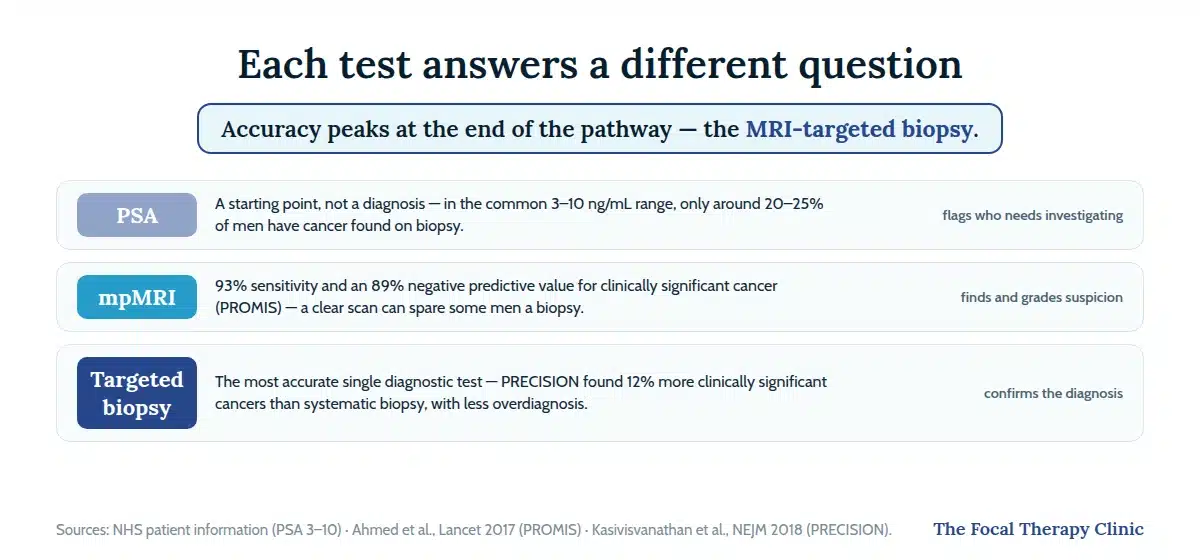
No single test provides a complete picture, and the most accurate approach uses tests in sequence under NICE NG131. This is why doctors rarely rely on PSA alone when testing for prostate cancer UK. The table below compares the main tests for prostate cancer:
| Test | Accuracy | Strengths | Limitations |
|---|---|---|---|
| PSA blood test | Most raised PSA results are not caused by cancer — in the common 3–10 ng/mL range, only around 20–25% of men have cancer found on biopsy | Simple, low cost, widely available, useful starting point | Cannot diagnose cancer alone and can rise due to BPH, infection, or inflammation |
| Digital rectal exam | Limited accuracy when used alone | Quick clinical check for hard or irregular prostate areas | Can miss cancers and has been de-emphasised in modern pathways |
| mpMRI | PROMIS found 93% sensitivity and an 89% negative predictive value for clinically significant cancer | Non-invasive, can identify suspicious areas, may help avoid biopsy | Can miss some cancers and needs expert reporting |
| MRI-targeted biopsy | PRECISION found 12% more clinically significant cancers detected than systematic biopsy; VISION found 36.3% vs 27.6% | Most accurate single diagnostic test, samples suspicious MRI-visible areas | Invasive test, though modern transperineal methods reduce infection risk |
For men asking about the most accurate test for prostate cancer, the answer is MRI-targeted biopsy. For men asking about the best test for prostate cancer at the first stage, the answer is usually PSA followed by mpMRI when indicated.
Get Expert Advice & The Latest Research
Subscribe to our newsletter to receive the latest updates, expert insights, and breakthrough research on prostate cancer-delivered straight to your inbox.
The Prostate Cancer Diagnostic Experience
Many men worry about discomfort during diagnostic procedures, but modern pathways have made testing far less invasive than many expect. The mpMRI scan is non-invasive, requires no anaesthetic, and helps doctors decide whether a biopsy is needed. Biopsy is only recommended when imaging and clinical findings suggest that tissue sampling is necessary.
What Happens During mpMRI
An mpMRI scan is entirely non-invasive and usually takes 30 to 45 minutes. The patient lies still while the scanner takes detailed images of the prostate and surrounding tissues. No anaesthetic is needed, and most men can return to normal activities straight after the scan.
Many men referred with a raised PSA do not ultimately need a biopsy. This can happen when the mpMRI shows no suspicious areas and the consultant agrees that monitoring is appropriate.
Transperineal vs Transrectal Biopsy
A transperineal biopsy samples the prostate through the skin between the scrotum and anus, while a transrectal biopsy samples the prostate through the rectum. The Focal Therapy Clinic uses the transperineal route because it avoids passing the biopsy needle through the rectal wall. Current evidence suggests this approach carries a lower infection risk than the transrectal route.
| Biopsy Route | Key Characteristics |
|---|---|
| Transperineal biopsy | Accesses the prostate through the perineum, avoids passing the needle through the rectal wall, and has a lower infection risk |
| Transrectal biopsy | Accesses the prostate through the rectum, was historically common, but carries a higher infection concern because of rectal bacteria |
Which Prostate Cancer Test Should You Have?
The right prostate cancer test depends on individual circumstances, including age, PSA level, family history, symptoms, previous investigations, and personal priorities. At The Focal Therapy Clinic, consultant urological surgeons follow the NICE-recommended stepped pathway, starting with PSA and clinical review before moving to mpMRI. MRI-targeted biopsy is only recommended when the results suggest that tissue sampling is needed.
Factors Influencing Test Selection
Doctors do not choose tests in isolation. They look at the full clinical picture to decide which step is most appropriate and whether further investigation is needed. The aim is to detect clinically significant cancer early while avoiding unnecessary invasive procedures.
| Factor | How It Affects Test Selection |
|---|---|
| Age and general health | Helps decide whether testing and treatment would offer meaningful benefit |
| Family history and genetic risk | May support earlier testing or genetic assessment |
| PSA levels and trends | Rising or persistently raised PSA may prompt mpMRI |
| Presence of early symptoms | Urinary or other symptoms may guide referral and assessment |
| Previous investigations | Prior PSA, MRI, or biopsy results affect whether repeat testing is needed |
| Patient preferences | Some men want maximum certainty, while others want to avoid unnecessary invasive tests |
These decisions should always be made with a clinician who can explain the benefits and limits of each option. This helps men understand why one test may be recommended over another.
Discussing Options With Your Doctor
Open conversations with a doctor can make the diagnostic process clearer and less stressful. Consultants can explain what test results mean, whether further testing is needed, and which treatment approaches may be medically suitable. This is especially important for men who already have a diagnosis and want to understand all available options.
The Focal Therapy Clinic care pathway is designed to review each case in detail, including PSA results, mpMRI findings, biopsy results, cancer location, and personal quality-of-life goals. A specialist review can help men understand whether focal therapy, surgery, radiotherapy, active surveillance, or another route is most appropriate.
Frequently Asked Questions
What is the most accurate test for prostate cancer?
An MRI-targeted biopsy is the most accurate single test for diagnosing prostate cancer. It uses mpMRI findings to guide tissue sampling from suspicious areas. This gives doctors a more reliable diagnosis than random systematic biopsy alone.
How accurate is multiparametric MRI for detecting prostate cancer?
The PROMIS trial found that mpMRI had 93% sensitivity and an 89% negative predictive value for clinically significant prostate cancer. This means a clear scan can help some men avoid biopsy. It is accurate, but it can still miss some cancers.
Do I need a biopsy if my PSA is raised?
Not always, because a raised PSA can be caused by BPH, infection, inflammation, or age-related prostate enlargement. NICE recommends mpMRI before biopsy for suspected clinically localised prostate cancer. If mpMRI is clear, biopsy may be avoided after shared decision-making.
Can prostate cancer be missed by an MRI?
Yes, prostate cancer can be missed by MRI, although mpMRI is a strong test for clinically significant disease. This is why doctors consider PSA trends, risk factors, symptoms, and previous results — and why every MRI at The Focal Therapy Clinic is second-read by two specialist uroradiologists. Some men still need biopsy despite MRI findings.
Is a PSA test enough to diagnose prostate cancer?
No, a PSA test is not enough to diagnose prostate cancer. It is a useful starting point, but it cannot confirm whether cancer is present. Diagnosis usually needs mpMRI and, when suspicious areas are found, targeted biopsy.
What happens if prostate cancer is diagnosed?
If prostate cancer is diagnosed, doctors assess the stage, tumour location, PSA level, and Gleason score. These details help guide treatment choices such as active surveillance, focal therapy, surgery, or radiotherapy. Men should discuss lifestyle priorities and side-effect concerns with a specialist.
Speak to a Prostate Cancer Specialist
Men with concerns about PSA results, family history, symptoms, or diagnostic options should seek specialist advice from a prostate cancer specialist. The Focal Therapy Clinic’s consultant urological surgeons can review prior test results, advise on next steps, and explain the full diagnostic pathway, including whether focal therapy may be suitable. To discuss results or arrange a second opinion, book a prostate cancer consultation.
References
References verified via PubMed / official sources, 26 August 2026.
- Ahmed HU, El-Shater Bosaily A, Brown LC, et al. Diagnostic accuracy of multi-parametric MRI and TRUS biopsy in prostate cancer (PROMIS): a paired validating confirmatory study. Lancet 2017;389(10071):815–822. PMID 28110982.
- Kasivisvanathan V, Rannikko AS, Borghi M, et al. MRI-targeted or standard biopsy for prostate-cancer diagnosis (PRECISION). N Engl J Med 2018;378(19):1767–1777. PMID 29552975.
- Kasivisvanathan V, et al. MRI-targeted biopsy versus systematic biopsy for the detection of prostate cancer (VISION). Eur Urol 2024;87(5):512–523. PMID 39232979. (FTC co-author: Dr Aqua Asif)
- National Institute for Health and Care Excellence. Prostate cancer: diagnosis and management. NICE guideline NG131. https://www.nice.org.uk/guidance/ng131
- Cancer Research UK. Multiparametric MRI (mpMRI) scan for prostate cancer. https://www.cancerresearchuk.org/about-cancer/tests-and-scans/multiparametric-mri (accessed August 2026)
- Leeds Teaching Hospitals NHS Trust. Raised PSA — patient information. https://www.leedsth.nhs.uk/services/urology/common-urological-conditions/raised-psa/ (accessed August 2026)
- The Focal Therapy Clinic. Internal audit of MRI-ultrasound fusion targeted biopsies over 36 months to March 2026 — 881 patients, 2,235 targeted lesions, complete histology. Internal clinical audit data.
This information is for educational purposes and does not replace professional medical advice. All treatment decisions should be made in consultation with a qualified healthcare professional.